
Golf Cart Leaf Spring Sag: Do You Need Heavy Duty Springs?
Is your golf cart rubbing tires or leaning? We analyze the signs of spring fatigue and help you choose between Stock, HD, or Dual Action upgrades.
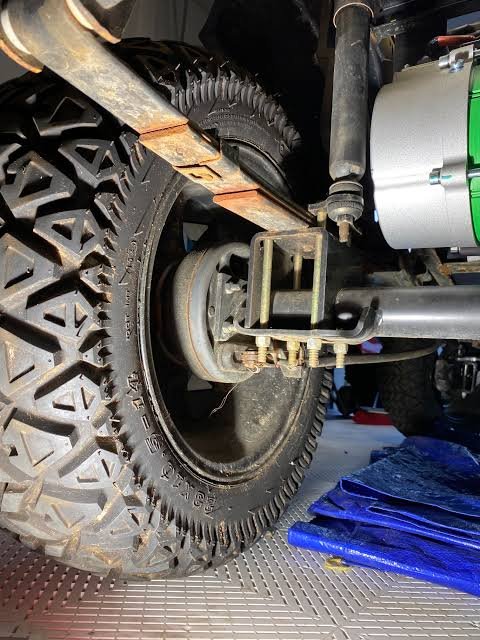
01 : Measuring the Sag Correctly
Before spending money, grab a tape measure to determine if your springs are truly fatigued or just overloaded. Sag is one of those problems that owners feel before they can see, so the tape gives you an honest baseline. Measure from the center of the rear axle tube up to a fixed point on the body, both sides, with the cart empty on flat concrete. Write the numbers down. Half the carts we inspect are not sagging at all, they are simply carrying a rear seat kit and a cooler full of drinks that the factory springs were never rated to hold.
- The Curb Height Test: Park on flat concrete. If the driver’s side is >0.5″ lower than the passenger side, the springs are fatigued.
- The Visual Check: Look for a distinct arch (smile). If the spring is flat or inverted (frowning), the metal has lost its tempered memory.
- The Load Test: Add ~400 lbs to the rear. A drop over 3″ or tire-to-fender contact indicates the springs are no longer capable of supporting your use case.
02 : Choosing the Right Spring Rate
Choosing the wrong spring rate ruins ride quality. Match the tier to your actual daily usage. This is where brand and era matter. Stock EZGO TXT and RXV carts from the 2010s run a fairly soft single or double leaf that sags early once a rear flip seat is bolted on, which is why the dual-action helper pack is so popular on those platforms. Club Car Precedent carts built from 2004 onward use a leaf pack that holds up better but is notorious for rust-welding the shackle bolts, so factor hardware replacement into any upgrade. Yamaha Drive and Drive2 carts, especially the 2017 and newer G29-derived models, carry a slightly stiffer factory rate and rarely need anything beyond a fresh OEM pack unless you are hauling four adults daily.
Resist the temptation to jump straight to the four-leaf extra heavy duty pack. We see it constantly: an owner adds a rear seat, panics about sag, and installs the stiffest spring on the shelf. The result is a cart that rides like a brick when empty and launches the driver out of the seat over every speed bump. Unless you are genuinely running a maintenance or hauling cart with constant payload, the dual-action pack delivers ninety percent of the capacity with none of the harsh empty-cart bounce.
1. Standard Duty (Stock)
Usually 1 or 2 leaves. Best for standard neighborhood cruising with no rear seat kit. Ride Quality: 10/10.
2. Heavy Duty (HD)
3 or 4 thick leaves. Required for work carts or constant 4-adult payloads. Trade-off: The cart will bounce aggressively when driving solo.
3. Dual Action (Recommended)
A standard pack with a shorter “helper” leaf. It stays plush when empty but engages extra stiffness only when weight is added. Best for 90% of readers.
03 : Capacity Benchmarks by Tier
Not all springs are equal. Use this lab-verified chart to match your payload requirements. Read capacity as a working figure, not a peak. A pack rated for 700 pounds should be loaded to roughly two-thirds of that for daily duty if you want the temper to last, because constantly maxing out a leaf pack is exactly what flattens the arch and causes the sag you are trying to cure in the first place.
| Spring Type | Leaves | Capacity | Ride Stiffness |
|---|---|---|---|
| OEM / Stock | 1-2 | 300 – 400 lbs | 1 (Softest) |
| Dual Action | 2+1 | 600 – 700 lbs | 3 (Moderate) |
| Heavy Duty | 3 | 750 lbs | 7 (Firm) |
| Extra HD | 4 | 1,000+ lbs | 10 (Brick) |
04 : Installation Protocol and Pitfalls
The install itself is straightforward, but a few small mistakes cause most comebacks. Work one side at a time so the axle cannot rotate and bind, and support the axle with a jack stand rather than letting it hang on the brake cables. On Club Car carts especially, plan to cut the rusted rear shackle bolt rather than fight it, since stripping the head means drilling and tapping later. Torque the U-bolts in a cross pattern and recheck them after the first ten miles, because a fresh leaf pack settles and the clamping force changes as it seats.
- One Side at a Time: Never disconnect both springs simultaneously, or the axle will rotate out of alignment.
- Centering Pin: Ensure the alignment pin on the spring drops perfectly into the axle plate hole to avoid “crab walking.”
- Bushing Inspection: If adding a rear seat, always replace bushings with polyurethane versions for better stability.
One last note on alignment. The centering pin must drop fully into the axle plate, or the cart will track slightly sideways, a condition owners describe as crab walking. Spend the extra minute to confirm both pins are seated before final torque, and replace tired bushings with polyurethane when you have the pack apart. That single step prevents the rear-end wander that often gets blamed on the springs themselves.
05 : Published spring references and sag measurement
Leaf count is a catalog comparison, not a universal capacity rating. Spring thickness, arch, mounting geometry, rear-seat hardware, and cart year matter. Confirm by model/year before ordering and never use a spring claim to exceed the cart’s vehicle rating.
| Platform and type | Published leaf count | Published added capacity | Fitment note |
|---|---|---|---|
| EZGO TXT standard rear replacement | 2-leaf listing, with OEM-era 3-leaf variants | Not published | Confirm by model/year. |
| EZGO TXT HD rear kit | 3 leaf | 300+ lb claimed | 1995-up catalog fitment, confirm by model/year. |
| EZGO TXT dual-action HD | Progressive helper design | Not published | MadJax says helper support engages under load. |
| Club Car DS HD kit | 3 leaf | 300+ lb claimed | 1982-up catalog fitment, confirm by model/year. |
| Club Car Precedent HD rear kit | 4-leaf retail option | Not published | 2004-up fitment, confirm by model/year. |
Measurement method: on level ground and with correct tire pressure, measure vertically from the same fixed frame or body point to the axle centerline. Record unloaded height, then repeat with normal passengers or cargo. Compare loaded sag and left-to-right difference. Flat or cracked leaves, uneven height, or bump-stop contact at normal load justify spring work.
FAQ
How do I know if leaf springs are sagging?
Measure the same frame-to-axle points unloaded and under normal load. Look for a flat arch, cracks, unequal side-to-side height, or bump-stop contact.
Do heavy-duty springs ride rough?
Often when unloaded. A dual-action spring attempts a softer initial ride and extra support once the cart is loaded.
Can shocks fix spring sag?
No. Shocks control motion; they do not restore a leaf spring’s arch or carrying ability.
Should both rear springs be replaced?
Yes. Replace them as a pair and inspect bushings, sleeves, shackles, U-bolts, and shock mounts.
