Fix Loose Steering: Adjusting Box Lash on EZGO & Club Car
Driving straight but constantly sawing the wheel? We show you how to mechanically tighten the internal gear gap on EZGO and Club Car racks.
01 : Why the Dead Zone Develops
As you drive over bumps for years, the metal teeth inside your rack wear down, creating a tiny gap between the Pinion and the Rack. This gap manifests as “slop.” On EZGO TXT carts from the early 2000s onward and Club Car Precedents built from 2004, this wear accelerates if the cart is stored outside, because grit packs into the rack and acts like grinding paste every time you turn. The first symptom owners notice is having to saw the wheel back and forth to hold a straight line, which feels like a tie rod problem but usually is not.
Understand that lash is normal wear, not a defect. Every rack and pinion or steering box develops a little play over thousands of miles, and the manufacturers built in an adjuster precisely because they expected it. The goal of the adjustment is to remove the slop without crushing the gears together, which is a balance you reach in small steps rather than one big turn.
The Fix: Guide Shoe Adjustment
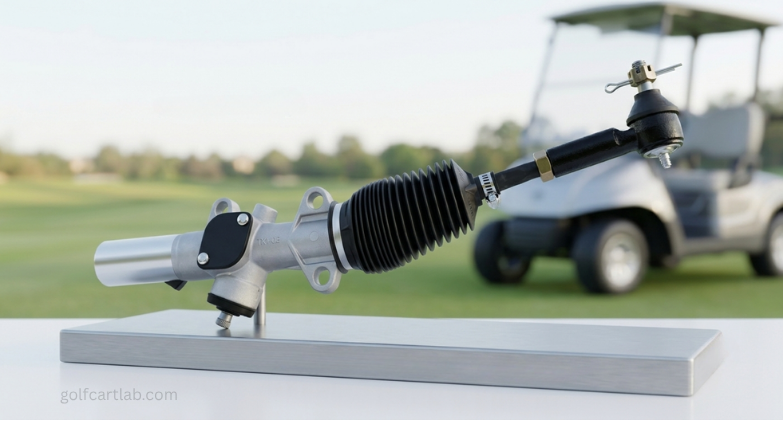
Manufacturers include a “Lash Adjuster” screw. This pushes a friction block against the rack, forcing it back into tight contact with the pinion gear.
02 : Isolating the Real Cause
Before turning screws, verify the source of the play with the engine off.
- The Test: Have a helper watch the front driver-side tire while you wiggle the steering wheel.
- Scenario A: Steering moves >1 inch before tire moves = Excessive Lash.
- Scenario B: Steering moves, tie rod moves, but tire doesn’t = Bad Tie Rod End.
03 : Club Car Procedure
Applies to Precedent (All Years) and DS (2009+). Tools: 3/4″ Wrench, Flathead Screwdriver. One Club Car quirk worth knowing is that the Precedent rack from 2004 onward sits low and rearward, so road spray hits the adjuster nut constantly and it corrodes. Spray it with penetrant the night before and let it soak, because forcing a seized jam nut will round it off and turn a ten-minute job into a rack replacement. The DS models before 2009 used a different steering box, so confirm which assembly you actually have before you start.
- Lift the Front: Tires must be off the ground to prevent binding.
- Locate Adjuster: Find the large nut with a center screw on the rack assembly (facing rear).
- Loosen Jam Nut: Back off the large outer nut 2 turns.
- The Adjustment: Turn the center screw Clockwise.
- Lab Rule: Turn only 1/8th of a turn at a time. Check for binding after each turn.
04 : EZGO Procedure
EZGO uses two distinct systems depending on the year, and getting the year right is half the battle. Mixing up the procedures is the most common mistake we see on these carts, so check your serial sticker before you touch a wrench.
1. Frame-Mounted Rack (2001+ TXT & RXV)
Located on the passenger side of the rack assembly. Loosen the large Jam Nut, tighten the inner plug to 10-15 ft-lbs, then back it off 1/4 turn to pre-load the spring.
2. Axle-Mounted Box (1994-2001 TXT)
Located on top of the axle box. Loosen the jam nut, turn the slotted screw clockwise until seated gently, then back off 1/8 turn.
After any lash adjustment, the single most important verification is the lock-to-lock spin. With the front still lifted, turn the wheel slowly from full left to full right and feel for a tight spot. If the steering binds or hangs at any point in the arc, you have gone too tight, and you must back the adjuster off until it spins smoothly through the entire range. A tight spot here is what causes memory steer and chewed rack teeth down the road, so never skip it. Lower the cart, take it for a short drive, and confirm the wheel returns to center on its own after a gentle turn. If it does, lock the jam nut and you are finished.
If you remove all the slop and the steering still wanders, the lash was a symptom and not the disease. Look next at worn tie rod ends, a loose pitman arm, or sloppy kingpin bushings, all of which mimic rack play. Carts that have been curb-hopped or jumped often crack the rack mount tabs, and no amount of adjustment will tighten a steering system that is physically loose at the chassis.
Summary Checklist
- Identify your system: Rack & Pinion vs. Steering Box.
- Lift the front end: Never adjust lash with tires on the ground.
- Small increments: 1/8th turn at a time.
- The Lock-to-Lock Test: Ensure the wheel spins freely from far left to far right.
- Secure the Jam Nut: If this loosens, you lose steering control.
One platform note worth knowing before you turn a single bolt: the Club Car DS and Precedent use a rack-and-pinion steering box, so the lash adjustment is the sector-shaft screw on top of the housing, while older E-Z-GO Marathon and TXT carts use a bell-crank tie-rod linkage where most of the felt slop is actually in the worn tie-rod ends and king-pin bushings rather than the box itself. That is why a TXT that still feels loose after a by-the-book box adjustment almost always needs the tie-rod ends replaced next, not another quarter turn on the screw.
05 : Published steering adjustment values
Do not apply a generic torque to a lash adjuster. The Club Car DS rack procedure uses rolling resistance. Public TXT and RXV references do not give one interchangeable lash-adjuster torque, so identify the exact steering system first.
| Platform | Method | Published value |
|---|---|---|
| Club Car DS rack, 2008 procedure | Bottom the adjuster, back off 1/4 turn, then check resistance | 7 to 15 in-lb rotational resistance; lock nut 28 ft-lb |
| EZGO TXT | Inspect rack, rod ends, mounts, and column first | No universal public lash or jam-nut torque found for every version |
| EZGO RXV | Use the exact-year service procedure and inspect rack, rod ends, kingpins, and suspension | No universal public lash-adjuster torque found in the references used |
Where the maker does not publish a value, use a feel check: with the front safely raised, turn lock to lock slowly. Stop if there is binding, a tight center spot, or poor return. Tightening cannot repair a loose rod end, worn kingpin, cracked mount, or damaged rack.
FAQ
How much steering play is normal?
A small amount is normal, but the tires should respond promptly without clunking or binding. Inspect each joint before adjusting a box.
Will tightening the box fix loose steering?
Only if internal lash is confirmed. It cannot repair worn joints, bushings, column couplers, or mounts.
Should wheels be off the ground?
Raise and support the front for inspection and smoothness checks, then finish with a grounded road test. Never work under a cart supported only by a jack.
Do I need alignment after steering work?
Check alignment after rod-end, rack, or suspension changes. Marking an old position helps but is not an alignment check.