Golf Cart Solar Charging: Panel Sizing, Cost & Payback
How to size a solar panel to your daily miles, what a realistic MPPT setup costs, and whether it actually pays off, with real controller-efficiency numbers and a free payback calculator.
- Size from your driving: at 150 Wh/mi and 85 percent efficiency, each mile needs about 176 Wh from the panel.
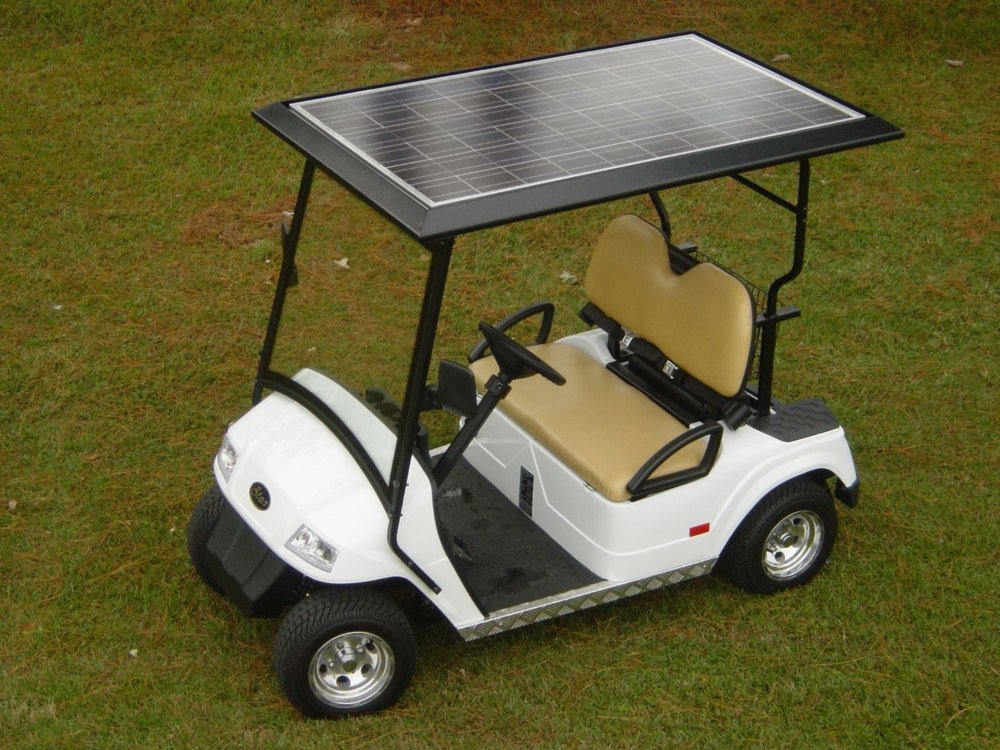
- Most cart roofs fit 300 to 500W; 8 miles a day needs roughly a 400W panel over 5 sun-hours.
- An MPPT controller harvests meaningfully more than a cheap PWM one, especially in cold or low light.
- Payback is usually slow on pure electricity savings; the real wins are added range and off-grid charging.
01 : How Golf Cart Solar Charging Works
A solar setup has three parts: the panel, a charge controller that matches the panel’s output to your battery voltage, and the battery pack itself. The panel produces DC power when the sun hits it; the controller regulates that into a safe charging current; the pack stores it. On a roof-mounted system the panel trickle-charges all day while the cart sits or drives, topping up between trips rather than replacing a full overnight charge.
Controller type matters. Morningstar says MPPT controllers can increase solar-array energy harvest by 5 to 30 percent compared with PWM, depending on climate and the voltage match between the array and battery. The reason is that an MPPT controller lets the solar array operate near its maximum-power voltage and converts that power down to the battery voltage, while a PWM controller effectively pulls panel voltage toward the battery. Victron describes the same idea: MPPT decouples array voltage from battery voltage, so panels can be wired at a higher voltage than the battery pack.
Real-world output is always less than a panel’s nameplate rating. Heat, angle, dust, wiring losses, and clouds mean you should plan on roughly 75% of rated wattage in good conditions. A 400W panel over 5 peak-sun hours therefore yields about 400 x 5 x 0.75 = 1,500 Wh (1.5 kWh) per day, not the 2.0 kWh the label might suggest.
02 : How Much Solar Do You Actually Need?
Start from your driving, not the panel. At a typical 150 Wh/mile and 85% charging efficiency, every mile needs about 176 Wh from the panel. So 8 miles a day needs roughly 8 x 0.176 = 1.4 kWh, right at what a 400W panel delivers in 5 sun-hours. Drive farther, or live somewhere cloudier, and you will need a bigger panel or to keep grid-charging as backup.
| Daily Miles | Energy Needed | Panel @ 5 Sun-Hours |
|---|---|---|
| 4 miles | ~0.7 kWh | ~200W |
| 8 miles | ~1.4 kWh | ~400W |
| 12 miles | ~2.1 kWh | ~600W |
| 18 miles | ~3.2 kWh | 900W+ or grid backup |
Roof space is the practical limit, because most cart roofs fit 300 to 500W before weight, wind load, and mounting become awkward. A grounded hardware example is two 200W 24V-class rigid panels wired in series into a 48V-capable MPPT controller. Renogy’s 200W N-Type panel page lists 200W output, 31.03V optimum operating voltage, and 6.46A optimum operating current. Two in series would make roughly 62Vmp, enough headroom for a 48V golf-cart pack when matched to the right controller. Victron’s SmartSolar MPPT 100/20-48V technical specs list a 48V battery option, 20A maximum battery current, and 1160W nominal PV power at 48V, so a 400W roof array is well inside the controller’s current capacity as long as cold-weather Voc stays under the 100V input limit.
For how driving distance maps to battery drain, see how far a golf cart can go on one charge.
03 : Does Golf Cart Solar Charging Pay Off?
Be honest with the payback math. Charging a cart from the grid is already cheap, only a few cents a mile, so the dollar savings from solar are modest. A typical $900 roof kit offsetting 8 miles a day might save around $80 a year on electricity, putting simple payback past a decade. The real wins are non-financial: extended range on long days, never plugging in, and the ability to charge where there’s no outlet at all (campgrounds, lake lots, remote acreage).
Run your own numbers, panel wattage, sun hours, cost, and your power rate, through our solar charging payback calculator. It tells you what percentage of your driving solar covers and how many years until it pays for itself. To compare ongoing energy cost with grid charging, the charge vs. gas cost tool is a useful companion, and the charging time calculator shows how a panel’s output translates into hours of charge.
If you want to dig into panel angle, peak-sun-hour data for your area, and system sizing in more depth, the U.S. Department of Energy’s solar energy guide is a solid neutral reference.
04 : Getting the Most From a Solar Setup
A few practical choices decide whether a solar kit actually delivers its promised yield. Panel placement is first: a flat roof-mounted panel collects less than one angled toward the sun, but on a cart that moves and parks in different spots, a flat mount is the realistic compromise. Keep the panel clean, dust and pollen can quietly cut output by ten percent or more over a season.
The charge controller matters more than buyers expect. A cheap PWM controller wastes some of the panel’s potential, while an MPPT controller squeezes more usable charge out of the same panel, especially in less-than-ideal light. On a system you are paying real money for, the better controller usually pays for itself in delivered energy.
Finally, match expectations to your climate. Five peak-sun-hours is a reasonable average for much of the sunbelt, but cloudy northern regions may see three or fewer in winter, which roughly halves the daily yield. If you live somewhere with long gray stretches, treat solar as a range extender that tops up the pack rather than a full replacement for grid charging, and keep your wall charger as backup. Sized and set up sensibly, a solar kit quietly adds free miles every sunny day.
05 : Solar and Battery Chemistry
Your battery type shapes how well solar charging works. Lithium (LiFePO4) packs accept charge more efficiently and tolerate the partial, irregular top-ups that solar delivers throughout the day, which makes them an excellent match for a roof panel. Lead-acid packs work too, but they prefer full, regular charge cycles and can suffer if they are left sitting partially charged for long stretches, so a solar trickle should supplement rather than replace a proper full charge.
Whatever the chemistry, size the charge controller to your pack voltage and never exceed the battery’s recommended charge current. A correctly matched controller protects the pack and ensures the energy your panel collects actually makes it into storage. Treat solar as part of a healthy charging routine, not a substitute for understanding your batteries, and it will extend both your range and your pack’s lifespan.
The Bottom Line
Golf cart solar charging is great for adding range and going off-grid, and a 400W panel can cover light daily driving, but plan on a long payback since grid charging is already cheap. Size the panel to your miles and run the payback tool before you buy. Math Verified
Frequently Asked Questions
Can a solar panel fully charge a golf cart?
For light daily use, yes. A 400W roof panel getting about 5 hours of good sun can offset roughly 8 miles of driving per day. Heavier driving or cloudy climates need a larger panel or grid charging as backup, since real output is usually about 75 percent of a panel nameplate.
Should I use a PWM or MPPT solar charge controller?
Use MPPT for a cart setup. An MPPT controller extracts more usable charge than a cheaper PWM controller, with the advantage widest in cold or low light and when the panel voltage sits well above the battery voltage. On a system you are paying real money for, the MPPT premium is usually worth it.
Is golf cart solar charging worth it?
It is worth it for added range and off-grid charging, but rarely for pure electricity savings. Grid charging is already only a few cents per mile, so payback on a typical kit often exceeds ten years. Run the payback calculator with your own numbers.
How big a solar panel do I need for a golf cart?
Work back from daily miles. About 4 miles a day needs roughly 200W, 8 miles about 400W, and 12 miles about 600W over 5 sun-hours. Beyond what fits a roof, a ground-mounted home panel that charges the cart while parked is the practical option.