Golf Cart Cost Per Mile: Electric vs. Gas (Real Numbers)
What it really costs to run a golf cart per mile, worked from current EIA electricity and AAA gas prices, with a side-by-side table and a free cost-per-mile calculator.
- Electric cost per mile is energy used times your power rate, divided by charging efficiency (about 0.85).
- At 150 Wh/mi and the current U.S. average rate near $0.1883/kWh, that is about $0.033 per mile.
- A gas cart at 35 MPG and about $3.998/gal costs roughly $0.114 per mile, over three times the electric figure.
- Cost per mile is only the energy line; battery replacement and gas maintenance shape the true budget.
01 : What It Costs to Charge an Electric Cart
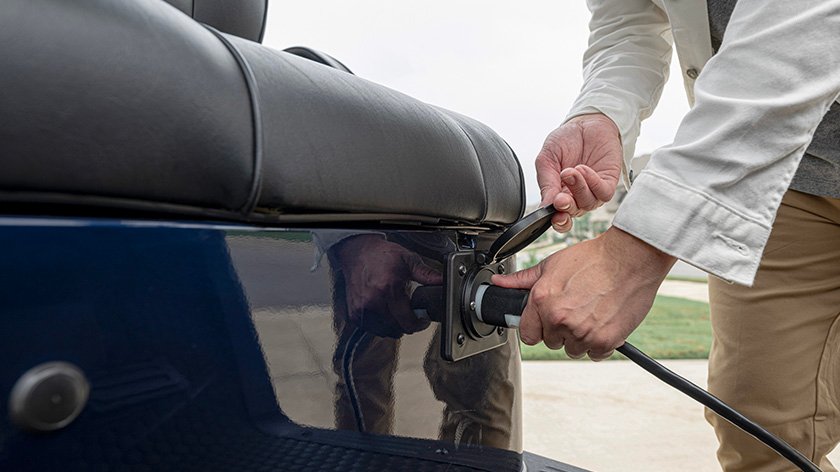
Electric cost per mile is just energy used times your power rate, divided by charging efficiency. A typical 48V cart uses around 150 watt-hours per mile on mixed terrain, less on flat pavement near 110 Wh/mi, and more when loaded or climbing near 200 Wh/mi. Chargers are not perfect, so divide by about 0.85 to account for charging losses.
The formula is simple: cost/mile = (Wh per mile / 1000) / 0.85 x electricity rate. The old 16 cent example is now low for the national average. EIA Electric Power Monthly Table 5.3 lists the U.S. residential average price at 18.83 cents/kWh in April 2026, released June 25, 2026. At 150 Wh/mi, the calculation is (0.15 / 0.85) x $0.1883 = $0.033 per mile. Even at that updated national average, electric energy cost is still only about three cents per mile.
02 : What It Costs to Run a Gas Cart
Gas cost per mile is fuel price divided by fuel economy. A gas golf cart gets roughly 30 to 40 miles per gallon, so 35 MPG is a reasonable middle example. AAA listed the U.S. regular gasoline current average at $3.998/gallon on July 19, 2026. At 35 MPG, that is $3.998 / 35 = $0.114 per mile. EIA’s weekly gasoline table is also useful for a dated government check; its July 14, 2026 release listed the July 6 U.S. regular all-formulations weekly price at $3.777/gallon.
| Cart Type | Energy Use | Rate | Cost / Mile |
|---|---|---|---|
| Electric (efficient) | 110 Wh/mi | $0.1883/kWh | ~$0.024 |
| Electric (typical) | 150 Wh/mi | $0.1883/kWh | ~$0.033 |
| Electric (loaded/hills) | 200 Wh/mi | $0.1883/kWh | ~$0.044 |
| Gas | 35 MPG | $3.998/gal | ~$0.114 |
03 : Your Real Golf Cart Cost Per Mile
The numbers above are national examples from April and July 2026, not a promise about one utility bill or one gas station. Your real golf cart cost per mile depends on your exact electricity rate, gas price, terrain, and how heavily you load the cart. At the updated national anchors, the typical electric example is about 3.3 cents per mile and the gas example is about 11.4 cents per mile, a spread of roughly 8.1 cents per mile before maintenance.
Rather than estimate, plug your own figures into our charge vs. gas cost-per-mile calculator. It compares both side by side and shows your annual savings at your real mileage.
Cost per mile is only the energy piece, though. To see the full picture, purchase price, batteries, maintenance, insurance, and resale, run the cost-of-ownership calculator, which builds a five-year total for your specific cart.
04 : So Which Is Actually Cheaper?
For day-to-day driving, electric wins on running cost almost every time, often saving $100-$150 a year at a couple thousand miles, and more if you drive a lot. Gas only catches up in narrow cases: very long days far from an outlet, heavy towing, or if your electricity is unusually expensive and gas unusually cheap. Up front, gas and electric carts cost similar amounts new; the divergence is almost entirely in fuel and maintenance over time. For the broader buying decision, see our gas vs. electric golf cart guide and our breakdown of how much a golf cart costs.
05 : Costs Beyond the Per-Mile Number
Cost per mile captures fuel and electricity, but it is only one line in the real ownership budget. Electric carts shift their biggest expense to the battery pack, which is a periodic replacement rather than a per-mile cost, a lead-acid pack might last four to six years, a lithium pack ten or more. Spreading that pack cost across the miles you drive gives a truer picture than energy alone.
Gas carts trade the battery worry for routine maintenance: oil and filter changes, spark plugs, belts, and the occasional carburetor service. None of that is expensive on its own, but it recurs every season and adds both cost and downtime. Electric drivetrains have far fewer wear items, which is a large part of why total cost of ownership usually favors electric even when the upfront prices are similar.
There are smaller line items too, insurance if you register the cart as a low-speed vehicle, tires, and the slow drift of resale value. The per-mile figure is the right place to start a comparison, but pair it with the full five-year view from the cost-of-ownership tool before you decide which cart is genuinely cheaper for your situation.
06 : How to Lower Your Cost Per Mile
If the running cost matters to you, a few habits noticeably lower it. Keeping tires properly inflated reduces rolling resistance, and a well-maintained drivetrain wastes less energy, so both stretch each charge further. Driving smoothly, easing into acceleration rather than flooring it from every stop, cuts the watt-hours each mile demands, especially on a heavier cart or in hilly terrain.
The bigger lever is your energy source itself. Charging overnight on an off-peak electricity rate can shave a meaningful slice off the per-mile figure, and pairing the cart with a small solar setup can offset part of your driving entirely. On the battery side, a healthy pack holds charge efficiently while a tired one wastes energy as heat, so good battery maintenance quietly keeps your cost per mile where it should be. Small habits compound over thousands of miles a year.
If you want to sanity-check the electric figure yourself, the underlying number is simple: a typical 48V lead-acid golf cart pack holds roughly 2.5 to 3.5 kWh of usable energy and delivers about 25 to 40 miles per full charge, so a full recharge that costs 30 to 50 cents at an average US residential rate near 16 cents per kWh works out to just over a penny per mile. Charger and battery inefficiency add a little back, which is why real-world electric numbers land closer to 2 to 4 cents per mile rather than the theoretical floor.
The Bottom Line
Electric golf carts cost roughly 2-4 cents per mile versus 8-12 cents for gas, about a third as much, with far less maintenance on top. Run your own rate and mileage through the calculator to see exactly what you’d save. Math Verified
Frequently Asked Questions
How much does it cost per mile to drive an electric golf cart?
About 2 to 4 cents per mile at current prices. At a typical 150 Wh per mile and the current U.S. average residential rate near $0.1883/kWh, it works out to roughly $0.033 per mile after charging losses. Your local electricity rate is the biggest variable.
Is a gas or electric golf cart cheaper to run?
Electric is cheaper to run, usually about a third of the per-mile cost of gas. At current prices an electric cart is near $0.033 per mile versus roughly $0.114 for gas at 35 MPG, and electric needs far less maintenance. Gas only competes for very long days away from an outlet or heavy towing.
What is the formula for golf cart cost per mile?
For electric, cost per mile equals watt-hours per mile divided by 1000, divided by about 0.85 for charging losses, times your electricity rate. For gas, it is the fuel price divided by miles per gallon. Plug your own numbers into the cost-per-mile calculator for an exact figure.
Does electricity price change the answer much?
Yes, it is the biggest lever. Doubling your power rate roughly doubles the electric cost per mile, but electric still stays well under gas at almost any realistic U.S. rate. Charging on an off-peak rate lowers it further.