Bintelli Golf Cart Lithium Battery Problems (BMS): Fix
Lithium packs make the Beyond easier to maintain, but the BMS changes how failures appear. A protective shutdown can mimic a dead battery, a bad charger, or a drive fault, so start from the battery label, not a guess.
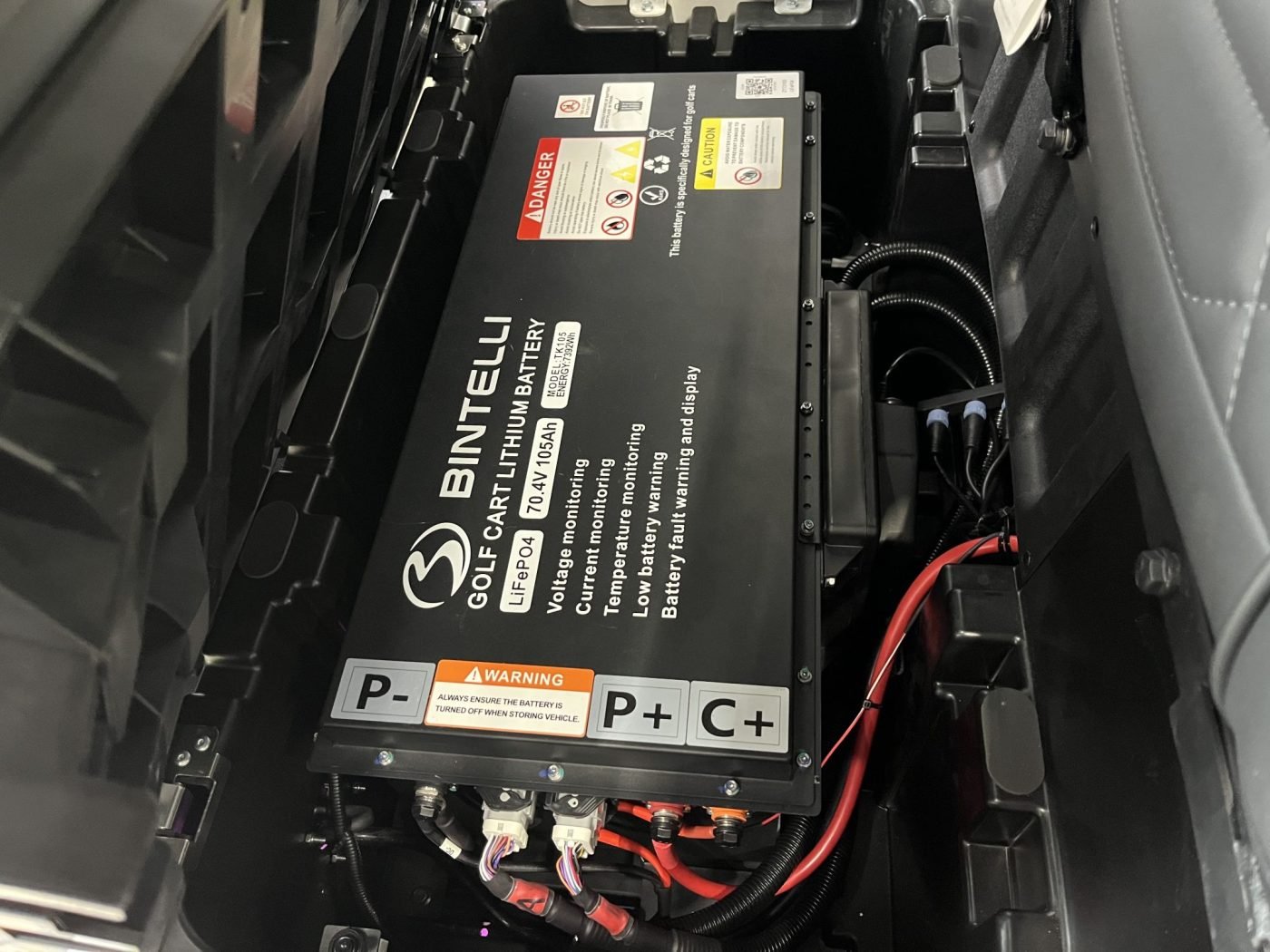
- Verified vehicle baseline (2025 Beyond 4 Passenger Lifted parts manual): 72V 165Ah lithium battery, 72V 5kW motor, JEVD1-72M450L controller, 400A fuse, main contactor. Older Beyond years and battery variants are not confirmed to share this spec, so read the label.
- Bintelli’s manual warns owners not to let the meter fall to 20 percent or less and never to let it reach zero percent. The low-voltage fault light means charge immediately.
- A loose or corroded high-current cable connection causes voltage drop under load, which can trip BMS protection even when the cells themselves are healthy. Check for heat and discoloration after a short drive.
- Eco Battery packs will not accept a charge below 32F internal temperature on standard models; heated models warm themselves first. This is protective behavior, not a fault.
- There is no verified public Bintelli-specific BMS voltage cutoff, cell-balance threshold, or pack-lug torque figure for every Beyond battery. Use the battery label, the battery maker manual, or Bintelli dealer service data for exact values, and never bypass the BMS.
Lithium packs make the Beyond easier to maintain, but the BMS can change how failures appear. A protective shutdown can mimic a dead battery, a bad charger, or a drive fault. Do not diagnose every Bintelli Beyond battery as the same pack: the label on the battery and charger is the final authority, and the BMS should be treated as protection to work around, not a fault to bypass.
01: Start From the Battery Label, Not a Generic Voltage
Do not diagnose every Bintelli Beyond battery as the same pack. The 2025 Beyond 4 Passenger Lifted parts manual verifies a 72V 165Ah lithium battery for that trim, plus a 72V 5kW motor, JEVD1-72M450L controller, 400A fuse, and main contactor. Older Beyond documents and battery variants do not publish one universal voltage and amp-hour spec, so the label on the battery and charger is the final authority.
- Label first: record voltage, amp-hours, chemistry, generation, and charger requirement.
- Battery switch: Bintelli’s current manual shows a physical battery power switch. If it is off, the cart will not run.
- BMS: treat shutdowns as protection until voltage, temperature, and connections are checked.
02: Match the Battery Symptom to the First Test
| Symptom | Likely Area | First Move |
|---|---|---|
| Cart fully dead | Battery switch, BMS sleep, fuse, pack output | Use the no-power guide |
| Will not charge | Charger, port, cold battery, BMS refusal | Use the no-charge guide |
| Slows or cuts out on hills | Voltage sag, current limit, heat, cable resistance | Use the reduced-speed guide |
| Dash shows low-voltage warning | Pack needs charge, or the BMS is protecting cells | Charge immediately and read pack voltage |
Bintelli says the low-voltage battery fault light means the battery needs to be charged immediately. It also says the lithium meter is not an exact percentage, and that owners should not let the meter reach 20 percent or less and should never let it reach zero percent.
03: Cable Heat, Voltage Drop, and Torque
Bintelli assigns owners responsibility for cleaning battery cables, keeping surfaces free of moisture and debris, and checking and securing connections to the battery. That is sourceable. A universal Beyond lithium pack-lug torque figure is not published in the public manuals available for this update. Use the torque printed on the battery label, the battery maker manual, or the Bintelli dealer service procedure. Do not invent a torque number for high-current lithium terminals.
For diagnosis, look for heat rather than guessing. After a short controlled drive, power down safely and compare cable ends for abnormal warmth, discoloration, melted insulation, loose hardware, or corrosion. A loose high-current connection can cause voltage drop under load, which can trigger BMS protection even when the cells are healthy.
04: Cold Charging and Temperature Protection
Eco Battery guidance is useful when the label on the cart confirms Eco hardware. Eco says its BMS blocks charging when internal temperature is below 32F on standard models, heated models warm themselves before charging resumes, and batteries can discharge colder than they can charge. If a cold cart refuses charge in an unheated garage, warm the battery core above freezing before condemning the charger.
This is not a nuisance feature. Charging lithium cells below freezing can permanently damage them, so the BMS declining to charge is protective behavior, not a defect.
05: Storage, Sleep, and Top Balancing
Bintelli tells owners the vehicle should be left plugged in when not in use and says the charger will trickle charge at 80 percent only when needed. Eco Battery recommends charging above 50 percent before storage, turning power off, charging at least once every six months, and fully charging after long-term storage to recalibrate state of charge. Eco also says leaving the charger plugged in for near-term use gives the BMS time to optimize and balance cells.
That gives a practical storage rule: do not park a Beyond empty, do not store it below freezing expecting it to charge, and do give the pack an occasional full charge so the BMS can top-balance cells where the battery maker supports that process.
06: What Thresholds Are Public, and What Is Label-Only
The public source set supports a few numbers: 72V 165Ah for the 2025 Beyond 4 Passenger Lifted battery, 400A for that trim’s main fuse, 20 percent as Bintelli’s recharge-before-this warning point, zero percent as a problem state to avoid, 32F as Eco Battery’s standard cold-charge block, and above 50 percent for Eco storage prep. There is no verified public Bintelli-specific BMS voltage cutoff, cell-balance threshold, pack-lug torque, or current-limit figure for every Beyond battery.
If you need those exact service values, use the battery label, battery manufacturer documentation, or Bintelli dealer service data for your serial number.
Read the label before you diagnose anything. Confirm the battery power switch, charge above 20 percent state of charge, warm a cold pack above freezing before charging, check cables for heat and looseness, and never let the pack sit at zero percent or bypass the BMS. Use the battery-specific manual for exact torque and cutoff values.
Frequently Asked Questions
Why does my Bintelli lithium battery shut off?
The BMS may be protecting the pack from low voltage, high current, cold-weather charging, heat, cell imbalance, or wiring resistance. Record the symptom and check pack voltage, temperature, charger behavior, and cable condition before assuming the cells have failed.
Can a Bintelli battery sleep after storage?
Yes. Lithium packs can enter a protective sleep state after storage or a deep discharge. Use the correct charger, confirm the physical battery power switch is on, and follow the battery maker’s wake procedure rather than bypassing protection or forcing a charge.
Should I bypass the BMS on a Bintelli?
No. The BMS protects both the battery and the cart. Bypassing it can damage cells or wiring and creates a real safety risk, since a high-current lithium pack can deliver dangerous fault current if protection is defeated.
What torque should Bintelli battery cable terminals be?
There is no universal public torque figure for Beyond lithium pack terminals. Use the value printed on the battery label, the battery manufacturer’s manual, or a Bintelli dealer service procedure rather than guessing, since high-current lithium terminals need the correct spec to avoid a loose, hot connection.