What Year Is My Yamaha Golf Cart? Serial Decoder
Find your Yamaha serial number and match the model prefix to its production-year range to identify the model, era, and original voltage, using Yamaha’s own primary ID data.
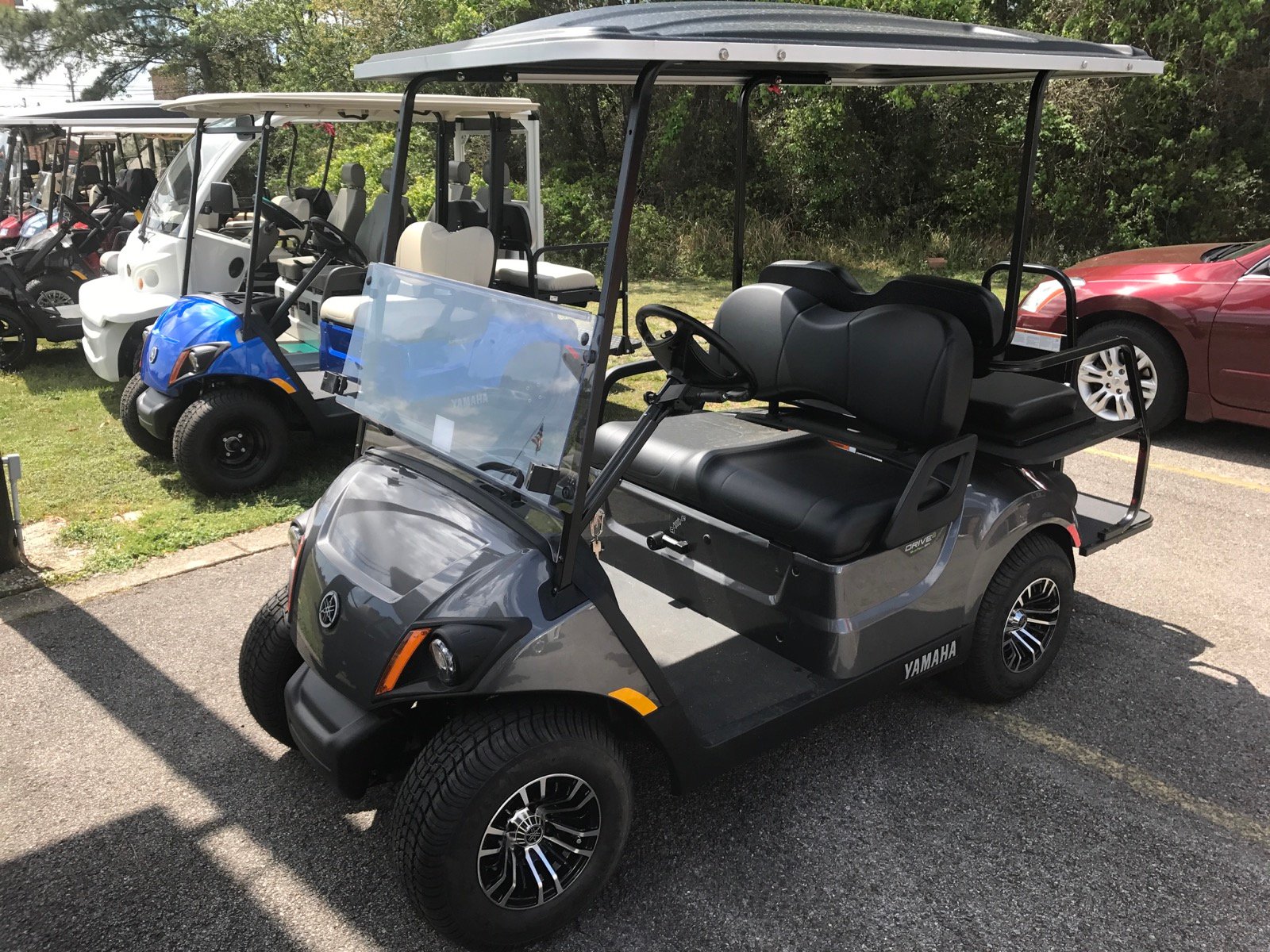
- Yamaha does not stamp a plain year; the serial prefix identifies the model, which maps to a year range.
- Real prefix examples: JW2 is the electric Drive (G29), JU2 is a G22E (2003 to 2007), JR1 is a G19E (1996 to 2002).
- Gas and electric are usually split across adjacent prefixes, for example JU0 gas versus JU2 electric.
- Confirm drivetrain and body generation by feature, since a converted cart keeps its original frame prefix.
Where to find your Yamaha serial number
On most Yamaha golf carts the serial number is stamped into the frame, often under the seat or on the body near the front. The important part for dating the cart is the first two or three characters, which identify the model. Yamaha does not stamp a plain model year the way a car does, so matching that prefix to the model is the reliable way to age the cart.
The exact stamping spot moved over the years, which trips up a lot of owners. On the older G1 through G9 carts the number is usually punched into the frame rail under the front cowl or on the driver-side inner fender, while on the G14 to G22 generation it is most often found on the frame crossmember beneath the seat, and on the Drive and Drive2 it sits on a plate near the front bumper or on the frame under the passenger-side floor. If years of grime hide it, a wire brush and a flashlight held at a low angle across the stamping will bring the characters back out.
The quickest method is the Yamaha serial number lookup tool, which reads the prefix and returns the model, its production year range, and the voltage or fuel type. For a brand-agnostic overview, see what year is my golf cart.
Yamaha model prefix guide
The most reliable public Yamaha source is Yamaha Golf-Car Company’s Primary ID Numbers PDF. It says the frame number contains the Primary ID and that the model code on the label helps identify the model. The table below keeps the broad family view, but adds the actual prefix codes readers see on the cart.
| Prefix or model code | Documented Yamaha model | Model years shown in Yamaha PDF | Gas or electric note |
|---|---|---|---|
| J10, J31 | G1A | 1979 to 1986, with later 1989 G1A data shown for J31 | Gas G1, two-stroke era |
| J14, J22, J26, J36 | G1E | 1980 to 1987 range in the Yamaha listing | Electric G1 |
| J38, JA2, J55 | G2A | 1985 to 1991 examples in the Yamaha listing | Gas G2 |
| J41, JE2, J56 | G2E | 1985 to 1991 examples in the Yamaha listing | Electric G2 |
| JG5 | G9A | 1991 to 1995 | Gas G9 |
| JG6, JH7 | G9E | 1991 to 1995 | Electric G9 |
| JN3 / JN4 | G14A / G14E | 1995 to 1996 | JN3 gas, JN4 electric |
| JN6 / JN8 | G16A / G16E | 1996 to 2002 | JN6 gas, JN8 electric |
| JR1 | G19E | 1996 to 2002 | 48V electric G19 |
| JU0 / JU2 | G22A / G22E | 2003 to 2007 | JU0 gas, JU2 electric |
| JW1 / JW2 | The DRIVE, YDRA / YDRE | 2007 to 2010 | JW1 gas, JW2 electric |
| JW8 / JW9 | The DRIVE, later YDRA / YDRE | 2011 to 2015 in Yamaha’s 2015 PDF | JW8 gas, JW9 electric |
| JC2 | YDRA EFI and 2011 Drive PTV Electric listings | 2011 to 2015 entries shown across the Yamaha PDF and location chart | Use the exact model label and features to separate EFI gas and PTV electric cases. |
The prefix is reliable for the platform family when it appears exactly in Yamaha’s Primary ID listing or serial-location chart. Later Drive2 carts may use labels and VIN-style identifiers beyond the 2015 PDF, so a prefix match should be paired with the model label, body style, and drivetrain before ordering expensive electrical parts.
Yamaha gas vs electric
Yamaha builds both gas and electric carts across most eras, and the serial prefix usually distinguishes the drivetrain. Electric Yamahas are commonly 36V on older G-series and 48V on the Drive and Drive2. If your decode reports a voltage, confirm it against the battery tray, since a previous owner could have converted the cart. For gas models, the move to efficient four-stroke and later fuel-injected engines on the Drive series is a useful era clue.
One Yamaha-specific quirk worth remembering: the G1 of 1979 to 1989 used a two-stroke oil-injection engine on its gas version, so if your cart has a separate oil reservoir and burns a smoky two-stroke mix, you are almost certainly looking at a G1 regardless of what a faded serial suggests. From the G9 onward Yamaha switched to clean four-stroke power, and the fuel-injected engines did not arrive until the Drive (G29) in 2007, so an EFI badge instantly rules out every G-series cart. These drivetrain milestones are often faster to read than a worn serial stamp.
Why the year matters
Identifying the model and year keeps part orders accurate. Controllers, chargers, and body components differ between the G-series and the Drive platform, and ordering by the correct model avoids expensive mismatches. The year also tells you the original voltage, which you can verify and then use with the battery voltage chart to read state of charge and the range calculator to estimate distance.
Bottom line
To find your Yamaha year, read the first characters of the serial number and match them to the model family, then use the production range as your year window. Drop the serial into the lookup tool to do the matching automatically, and confirm the result by checking whether the cart is gas or electric and which body generation it wears. With the model and era pinned down, you can buy the right parts, confirm the original voltage, and plan upgrades that fit a G-series or Drive correctly.
A worked example
Say the frame number starts with JW2. Yamaha’s Primary ID table lists JW2 under YDRE, the electric Drive, with starting numbers for 2007, 2008, 2009, and 2010. That puts the cart in the Drive or G29 electric family, not the older G16 or G19 era. If the prefix is JU2, the same Yamaha table points to G22E from 2003 to 2007; if it is JR1, it points to G19E from 1996 to 2002.
Gas and electric are often separated by adjacent prefixes. For example, Yamaha lists JU0 for G22A gas and JU2 for G22E electric, while JW1 is Drive gas and JW2 is Drive electric. If a used cart has been converted to lithium, received a replacement controller, or had body panels swapped, the serial prefix still identifies the frame family; the installed drivetrain still needs its own inspection before parts are ordered.
Frequently Asked Questions
How do I find the year of my Yamaha golf cart?
Read the first characters of the serial number. Yamaha encodes the model there, and each model maps to a production-year range. Enter the serial into the Yamaha lookup tool and it returns the model and its year span from Yamaha primary ID data.
What does a JW prefix mean on a Yamaha golf cart?
JW prefixes belong to the Drive and G29 generation. Yamaha lists JW1 as the gas Drive and JW2 as the electric Drive (YDRA and YDRE), with later JW8 and JW9 entries continuing into the 2011 to 2015 Drive range. Match the exact prefix to Yamaha primary ID data rather than guessing from JW alone.
Why does Yamaha show a year range instead of one year?
The serial prefix identifies the model, and each model was produced over several years, so the decoder reports that production range. To narrow it, compare features and options against known model-year changes.
Does the serial still work if the cart was converted to lithium?
Yes. The serial prefix identifies the original frame family even if the pack, controller, or body panels were later swapped. Use it to confirm the model, then inspect the installed drivetrain separately before ordering parts.