The “False Full” Battery Charge
The dash reads full, then the cart dies halfway around the block. That is a false-full pack: enough surface voltage to fool the meter, not enough capacity to do work. Here is how to strip the surface charge and read the truth with rested voltage, specific gravity, and a load test.
- False full is surface charge over a sulfated plate: the surface reads high right after charging, so the meter says 100%, but real amp-hour capacity has shrunk and collapses under load.
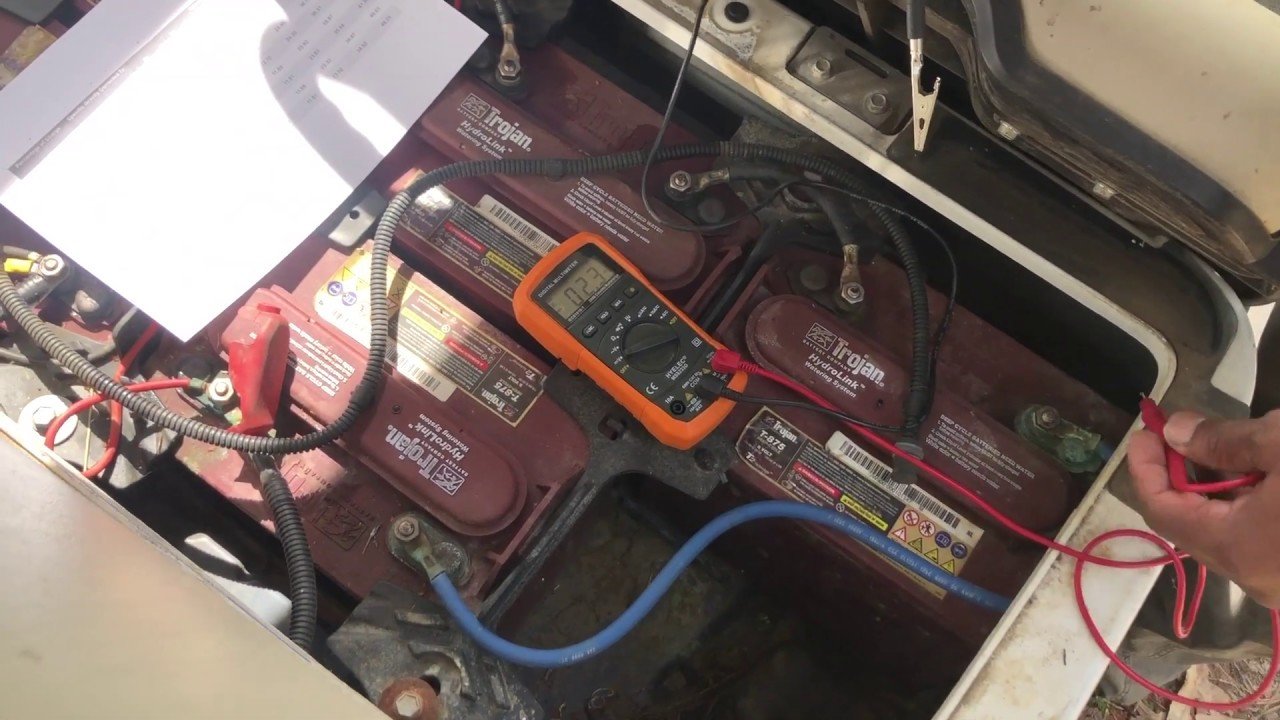
- Rested open-circuit voltage is the honest first number. Trojan’s chart puts a full 8V battery at 8.49V, 50% at 8.07V; a full 6V at 6.37V; a full 12V at 12.73V, read after at least 6 hours of rest, ideally 24.
- A voltmeter is roughly half the picture and a hydrometer is the whole picture on flooded cells: 1.277 SG is full, 1.172 is 50%, and a cell near 1.100 is effectively water.
- A pack is a series chain, so it performs like its weakest battery while five good ones prop up the resting voltage. That is why you often replace one battery, not six, and why the dash keeps reading full.
Your batteries are victims of the false-full charge. They have the voltage to trick the meter but lack the amperage to do any work, like a hollow log that looks solid and burns out in minutes. The cure is not a new charger or a hopeful equalize cycle, it is a handful of honest measurements that surface charge cannot fake.
The Sponge Analogy
Most dashboard meters are simple voltmeters that guess capacity from resting voltage. Picture a healthy battery as a sponge that holds water deep inside, and a sulfated battery as a rock that only gets wet on the surface. The moment you apply a load, that surface wetness dries instantly. Sulfation is the chemistry behind the trick: every time a lead-acid battery sits partly discharged, lead sulfate crystals harden on the plates and stop taking part in the reaction. The battery still shows a normal open-circuit voltage because the surface is charged, but its real capacity has shrunk. That is how six 8V batteries in a 48V cart can read a healthy 51 volts at rest and still die halfway around the neighborhood.
Stripping the Surface Charge
To see the truth you have to strip the surface charge and test the chemistry. Rest is the manufacturer-backed method for these flooded golf-cart batteries: disconnect the charger and all vehicle loads, then wait at least 6 hours, preferably 24. A short controlled load is sometimes used in starting-battery work, but the published Interstate method (150A for 10 to 15 seconds) is for a 12V cranking battery and must not be scaled to a 6V or 8V deep-cycle golf-cart battery, whose plate construction is entirely different. There is no defensible universal headlight time for every 36V and 48V cart, so the clean diagnostic is the rest interval because it needs no guessed load.
Rested Open-Circuit Voltage Reference
A dash bar graph estimates charge from pack voltage and cannot measure amp-hour capacity. A sulfated battery reaches a normal-looking charging voltage quickly because it accepts little energy, then collapses under load. The correct first comparison is rested open-circuit voltage per battery, using the flooded deep-cycle chart Trojan publishes. Read it after the battery has sat with no charge or discharge for at least 6 hours.
| State of charge | Specific gravity | 6V battery | 8V battery | 12V battery |
|---|---|---|---|---|
| 100% | 1.277 | 6.37V | 8.49V | 12.73V |
| 90% | 1.258 | 6.31V | 8.41V | 12.62V |
| 80% | 1.238 | 6.25V | 8.33V | 12.50V |
| 70% | 1.217 | 6.19V | 8.25V | 12.37V |
| 60% | 1.195 | 6.12V | 8.16V | 12.27V |
| 50% | 1.172 | 6.02V | 8.07V | 12.10V |
| 40% | 1.148 | 5.98V | 7.97V | 11.89V |
| 30% | 1.124 | 5.91V | 7.88V | 11.81V |
| 20% | 1.098 | 5.83V | 7.77V | 11.66V |
| 10% | 1.073 | 5.75V | 7.67V | 11.51V |
For a 36V pack of six 6V batteries these sum to about 38.22V at 100% and 36.12V at 50%. For a 48V pack of six 8V batteries they sum to about 50.94V at 100% and 48.42V at 50%. Those pack figures assume every battery is similar, so one weak unit can hide behind five strong ones; measure each battery, not just the total. Chemistry, temperature, and plate design vary, so use the battery maker’s own chart when it differs.
The Hydrometer: King of Tests
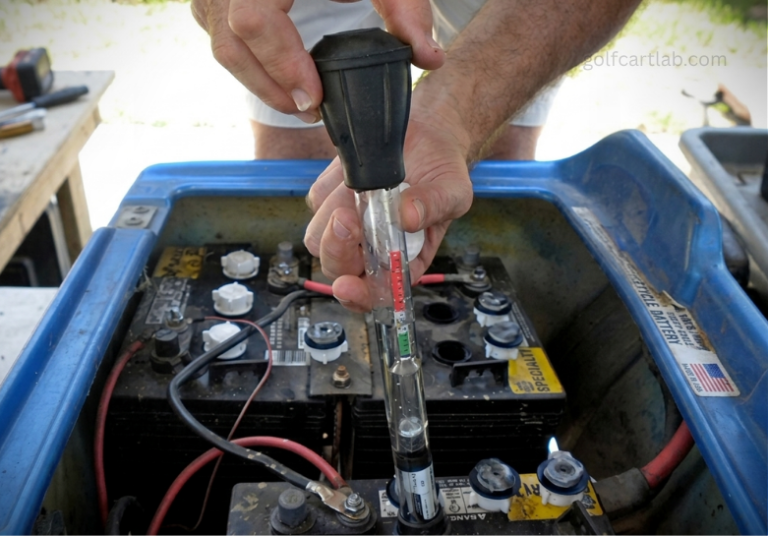
The only way to know if a wet-cell battery is truly full is to weigh the acid. A voltmeter is roughly half accurate; a hydrometer is a direct measurement of state of charge that surface voltage cannot fool, because specific gravity is the actual strength of the sulfuric acid. Test every cell of every battery and write the numbers down. Trojan lists 1.277 plus or minus 0.007 as its factory full-charge reference.
| Specific gravity | Zone | State of charge |
|---|---|---|
| 1.277 | Green | 100% (strong acid) |
| 1.200 | White | About 50% charged |
| 1.100 | Red | Dead cell (effectively water) |
A common finding on a five-year-old pack is that most cells read strong but one or two lag badly, and those laggards are your false-full culprits. Specific gravity drifts with temperature, so a cold battery reads slightly low and a hot one slightly high; most hydrometers print a temperature-correction scale for exactly this reason. If five batteries read 1.275 and one reads 1.100, that single short link is dragging the entire pack down to its level, and you likely need one battery, not six.
How to Read a Pack, Not Just a Gauge
| Observation | What it means | Next check |
|---|---|---|
| Rested pack voltage matches the table and all batteries are closely grouped | Present charge estimate is credible, but capacity is still unknown | Run a controlled capacity or load test if range is poor. |
| Dash shows full right after charging, but rested voltage falls into a lower band | Surface charge or premature charger termination created a false-full display | Check charger algorithm, connections, specific gravity, and charging current. |
| One battery is materially lower than its peers | The series pack is limited by the weakest battery | Measure every cell’s specific gravity and load each battery the same way. |
| Voltage looks normal at rest but collapses during acceleration | High internal resistance, low capacity, or a resistive cable | Record per-battery loaded voltage and cable voltage drop at the same current. |
| Voltage rises fast during charging while specific gravity stays low | Charge is not converting into usable active material | Verify electrolyte level, temperature, charger profile, and cell-to-cell SG spread. |
False-Full Diagnostic Sequence
- Confirm the charger profile matches the chemistry (flooded, AGM, or lithium) and the nominal pack voltage. Never equalize sealed or lithium batteries.
- For flooded batteries, inspect plates and add distilled water per the manufacturer. Do not overfill before charging.
- Complete a charge, disconnect all loads, and rest at least 6 hours, preferably 24.
- Measure the pack and every battery with the same calibrated meter, compare against the chart, and note the spread.
- Measure every flooded cell with a temperature-corrected hydrometer against the 1.277 reference.
- If rested voltage is plausible but range is short, run the manufacturer’s rated discharge test to its stated endpoint. Voltage alone cannot certify amp-hour capacity.
Why the Dash Gauge Fools You
Cheap LED bar graphs are programmed to read full at roughly 50V of surface charge and cannot see capacity. The fix for accurate telemetry is a coulomb counter, a shunt-based meter that physically counts the amps leaving the pack for a true 0 to 100% reading. A voltage gauge also moves under acceleration and regenerative braking because it sees terminal voltage, not chemical inventory: current through internal resistance creates an immediate drop, removing the load lets it rebound, and a charger creates the opposite lift. That is why a dashboard can swing from full to half and back without the battery gaining a single amp-hour.
Treat the dash meter as a trend display, never a verdict. Rested open-circuit voltage estimates state of charge, specific gravity checks individual flooded cells, and a controlled discharge measures true capacity. Use all three and you separate a harmless surface-charge reading from a charger problem, a resistive cable, or a genuinely worn-out battery. When you do replace, match the new unit in age and brand as closely as you can, because a fresh battery paired with five tired ones gets dragged down and worn out early by the company it keeps.
Frequently Asked Questions
Why does my golf cart battery meter read full then drop to empty?
This is surface charge. Right after charging, the voltage on the lead plates is artificially high, so the voltmeter-based dash reads 100%. If the batteries are sulfated or old they lack real capacity, so under load the surface charge dissipates almost instantly and the voltage crashes toward empty. Read rested open-circuit voltage after 6 to 24 hours, not the value right off the charger.
How do I test for a bad cell in my golf cart batteries?
Use a hydrometer to read the specific gravity of every cell. A fully charged healthy cell reads about 1.277. If one cell reads far lower, such as 1.100 or in the water range, that cell is dead and is dragging down the whole series pack. Compare each battery against the others rather than trusting the pack total, since five strong batteries can hide one bad one.
What is the difference between a voltmeter and a hydrometer?
A voltmeter measures electrical pressure, which surface charge can inflate, so it can be misleading. A hydrometer measures the density of the acid, which is a direct measurement of the battery’s true state of charge and cannot be fooled by surface charge. On flooded wet-cell batteries the hydrometer is the definitive test.
What is the resting voltage of a fully charged 48V golf cart pack?
A 48V pack of six 8V flooded batteries reads about 50.94V at 100% and 48.42V at 50%, based on Trojan’s per-battery chart of 8.49V full and 8.07V at half charge. Read it after the pack has rested at least 6 hours with no charging or driving. A pack that reads high right off the charger but sags below these numbers after resting is showing a false-full charge.