
Tire Sizes: Hacks to Read EZGO & Club Car Wheels
What do those numbers molded into the sidewall actually mean? Here is how to decode standard and metric golf cart tire sizes for your EZGO TXT, Club Car Precedent, and Yamaha G29, and confirm the fit before anything rubs.
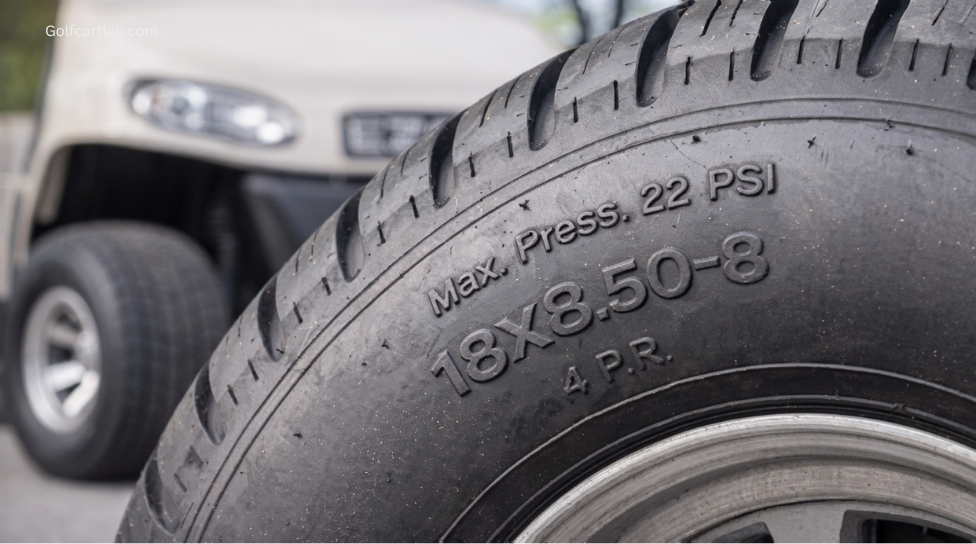
- Standard sizes (18×8.50-8) read as diameter x width – wheel in inches; metric sizes (205/50-10) read as mm width / aspect ratio – wheel in inches.
- Every printed size is nominal; a 205/50-10 calculates to about 18.07 inches but a real Kenda K399 measures near 18.3, so use the published actual dimension.
- Lift height has no universal max tire size; a 3-inch spindle Precedent lift lists up to 22 inches, a 6-inch A-arm up to 25 with the right hardware.
- Wheel offset decides where the tire sits, so diameter alone cannot predict rubbing. Verify clearance at full steering lock on both sides.
Most people do not search for “chassis telemetry” when they want new rubber. They type “what do the numbers on my golf cart tires mean?” or “will 20-inch tires fit my EZGO TXT?” The good news is that golf cart tire sizes become straightforward once the code is separated into width, sidewall, wheel diameter, and construction. The printed size tells part of the story, but the actual mounted diameter, wheel offset, suspension clearance, and the lift manufacturer’s application table decide whether the assembly really fits.
How Standard Golf Cart Tire Sizes Read
A size such as 18×8.50-8 uses the common flotation format:
- 18 is the nominal overall tire diameter in inches.
- 8.50 is the nominal section width in inches.
- 8 is the wheel diameter in inches.
The first number is the quickest height reference, but it stays nominal. Rim width, inflation pressure, load, and the tire mold can all change the measured result, which is why Kenda publishes actual dimensions in its product tables rather than assuming every tire with the same sidewall code measures identically.
How Metric Low-Profile Sizes Read
A size such as 205/50-10 uses width, aspect ratio, and wheel diameter:
- 205 is the nominal section width in millimeters.
- 50 means each sidewall is 50 percent of the section width.
- 10 is the wheel diameter in inches.
The nominal diameter works out like this: 205 mm x 0.50 = 102.5 mm of sidewall; (102.5 x 2) / 25.4 = 8.07 inches of combined sidewall; and 8.07 + 10 = about 18.07 inches nominal diameter. That calculation is a comparison tool, not a substitute for the tire maker’s dimension table. Kenda lists its 205/50-10 K399 at about 18.3 inches overall, which shows exactly why the published actual dimension should control clearance decisions.
Stock Height Versus Lifted Fitment
Lift height does not create one universal maximum tire size. Spindle, drop-axle, A-arm, and drop-frame kits move different components and can have different steering and suspension limits, so the current Nivel fitment table gives a useful model-by-model baseline.
| Platform and setup | Documented range or limit | Important condition |
|---|---|---|
| Stock-height Club Car, E-Z-GO, or Yamaha | 18-inch assemblies are the common documented baseline | Low-profile combinations can differ; confirm serial, wheel width, offset, and actual diameter. |
| Club Car Precedent, 3-inch spindle lift | Up to 22 inches in Nivel’s table | The table does not approve 23 or 25-inch tires for that kit row. |
| Club Car Precedent, 6-inch double A-arm lift | 20, 21, 22, 23, and 25-inch columns approved | Some 25-inch combinations require the specified low-profile hardware and heavy-duty springs. |
| E-Z-GO TXT, 5-inch drop-axle or 6-inch spindle lift | Through 25 inches in the listed rows | Use the exact kit’s instructions, because year ranges and suspension designs differ. |
| E-Z-GO TXT, unlisted 3-inch kit | No universal maximum in the current Nivel table | Use that kit maker’s model-year table and measure; do not borrow the Club Car 3-inch result. |
| Yamaha G22 through G29, 3-inch spindle lift | Up to 20 inches in the listed row | 21 inches and larger are not approved in that row. |
| Yamaha Drive, listed 6-inch A-arm or spindle lift | Through 23 inches | The table does not approve 25 inches for those rows. |
These are fitment-table results, not promises for every accessory combination. Rear seats, heavy batteries, worn springs, body kits, fender flares, and nonstandard wheels can all change clearance, and the installation manual for the exact lift kit takes priority if its limit is lower than a general catalog table.
Wheel Offset and Backspacing
Wheel diameter does not reveal where the tire sits. Offset is the distance between the wheel centerline and the mounting face: positive offset generally moves the wheel inward, negative offset moves it outward. Backspacing is the physical distance from the mounting face to the wheel’s inner edge.
| Example wheel | Published position | What it means for comparison |
|---|---|---|
| 8×7 steel wheel | Centered | The mounting face is near the wheel centerline; measure actual backspacing before swapping brands. |
| 10×7 GTW wheel | 3:4, ET -0.25 inch | About three inches of nominal width inward and four outward, with a quarter-inch negative offset. |
| 12×7 GTW wheel | 3:4, ET -0.25 inch | The same stated position on a larger wheel does not guarantee the same clearance, because tire width and shape matter too. |
| 14×7 GTW wheel | 3:4, ET -0.25 inch | Expect a more outward stance than a centered wheel, then verify stud, fender, and suspension clearance. |
The “3:4” description is a useful nominal split, but it is not a precision backspacing measurement, because wheel lips and bead-seat geometry affect where a straightedge lands. For a replacement, place a straightedge across the inner rim edge and measure to the mounting pad, then compare the candidate wheel’s published backspacing or measure it the same way.
Five Measurements Before Ordering
- Current tire diameter. Measure from floor to tread at normal load and compare with the new tire maker’s published overall diameter.
- Current section width. Measure the widest sidewall area, not only the tread.
- Inner clearance. Check spring, frame, tie rod, shock, and cable clearance at full steering lock.
- Outer clearance. Check body and fender clearance while the suspension is compressed.
- Wheel position. Record wheel width, offset or backspacing, bolt circle, center clearance, stud thread, and lug-seat style.
Repeat the steering check on both sides, because a cart can have different clearance left to right from alignment, body position, or previous repairs. After installation, torque the wheel nuts to the vehicle maker’s specification and recheck them after the initial drive interval stated in the wheel or vehicle instructions.
Load, Inflation, and Road-Use Labels
Tire size alone does not specify load capacity or inflation. Kenda’s 18×8.50-8 K389 illustrates the difference: its 4-ply-rated version is listed at 815 pounds at 22 psi, while its 6-ply-rated version is listed at 1,045 pounds at 34 psi. Use the exact sidewall and data sheet, then stay within the cart maker’s operating guidance, because the maximum molded on a tire is not automatically the best ride-pressure target.
A DOT-marked tire also does not make a golf cart street legal. Federal low-speed-vehicle rules address the vehicle as a complete system, including speed capability and required equipment, and state and local rules can add registration, lighting, insurance, and roadway restrictions. Treat the tire marking and vehicle legality as separate questions.
Decode the size, calculate only as a first estimate, then use the published actual dimensions and a model-specific lift table. Finish with physical clearance, wheel-position, load, and pressure checks. An 18×8.50-8 is roughly an 18-inch tire on an 8-inch wheel; a 205/50-10 is about 18.07 inches by formula; and the final authority is always the tire data sheet, the lift installation manual, and actual measured clearance together. The diagnostics library and repair guides cover related chassis and steering checks.
Frequently Asked Questions
What do the numbers on golf cart tires mean?
There are two formats. Standard sizes like 18×8.50-8 give the overall height, section width, and wheel diameter in inches. Metric sizes like 205/50-10 give the width in millimeters, the sidewall aspect ratio as a percentage of that width, and the wheel diameter in inches. Both are nominal, so the tire maker’s published actual dimension should control any clearance decision.
How do I read a metric golf cart tire size like 205/50-10?
In 205/50-10, the 205 is the tread width in millimeters, the 50 is the aspect ratio (sidewall height as 50 percent of the width), and the 10 is the wheel diameter in inches. That works out to about 18.07 inches nominal overall diameter, though Kenda lists its 205/50-10 K399 at about 18.3 inches, which is why the published actual figure should decide clearance.
Will changing tire size make my wheels rub?
It can. Larger tires can rub the steering rack or body, especially at full lock, which is why you decode the sidewall, use a model-specific lift table, and verify actual clearance before buying. Wheel offset matters too, because diameter alone cannot predict where the tire sits. Also check for uneven wear, since worn edges can signal an alignment issue a size change will not fix.
What is the biggest tire that fits a stock golf cart?
Eighteen-inch assemblies are the common documented baseline for a stock-height Club Car, E-Z-GO, or Yamaha, but low-profile combinations differ, so confirm the serial, wheel width, offset, and actual diameter. Bigger tires need a lift, and each kit design has its own approved maximum: a 3-inch Precedent spindle lift lists up to 22 inches, while a 6-inch double A-arm lift can approve 23 or 25 inches with the specified hardware.