How Long to Charge a Golf Cart? Times, Cost & Tips
Real-world charging times for 48V lead-acid and lithium golf carts, tied to verified OEM charger output, what changes the numbers, what it costs, and how to charge for the longest battery life.
- A depleted 48V lead-acid pack takes about 6 to 10 hours on a stock 13-15A charger; lithium charges faster on the same amperage.
- Yamaha’s QuiQ charger is verified at 18A max DC output, faster than the 13A Club Car ERIC (13A DC, verified on Club Car’s own sell sheet).
- A full charge from 30 percent costs well under two dollars in most areas.
- Use the charging time calculator with your actual pack Ah and charger amps for a real number, not a rule of thumb.
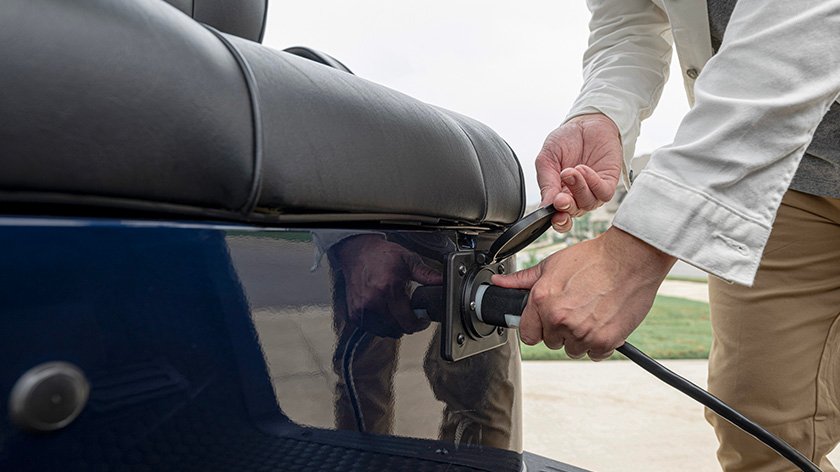
How long does it take to charge a golf cart? Most 48V electric golf carts take about 6 to 10 hours to fully recharge a depleted lead-acid pack on a standard 13 to 15 amp charger, while lithium carts often finish faster and tolerate higher-amp chargers. The exact time depends on how empty the batteries are, the pack capacity in amp-hours, the charger’s real output, and battery chemistry.
How long to charge a golf cart, by the numbers
Charging time comes down to one simple idea: how much energy you need to put back, divided by how fast the charger can deliver it. A nearly empty 48V lead-acid pack on a stock charger usually needs the better part of a working day or an overnight charge. A pack that is only half down might be full in three to five hours. Lithium packs of the same capacity tend to charge faster because they accept current more efficiently and can often use a higher-amp charger.
To get a real number for your own cart instead of a rule of thumb, plug your battery capacity, charger amps, and current charge level into the golf cart charging time calculator. It estimates hours to full, the energy added in kilowatt-hours, and the cost based on your electricity rate.
What your OEM charger actually outputs
The generic “13A or 25A” examples below only become useful once tied to a real charger. Here is what the documented OEM charger families actually output:
| OEM charger family | Verified output | What it means for the table below |
|---|---|---|
| Delta-Q QuiQ, E-Z-GO TXT/RXV world charger | Delta-Q’s E-Z-GO QuiQ manual identifies 913-4810 variants as 1 kW chargers, using a 10-LED ammeter to show output scale during bulk charge. | Treat common 48V QuiQ setups as roughly the same class as the 18A Yamaha QuiQ or the 13A to 25A planning examples, then confirm the label. |
| Yamaha QuiQ 1000, P/N JW2H210713 | Delta-Q’s Yamaha QuiQ manual lists 48V nominal, 67.2V max, and 18A max DC output. | Use 18A for Yamaha Drive and Drive2 carts with this charger, not the generic 13A row. |
| E-Z-GO PowerWise QE 48V | The PowerWise QE manual says the charger switches from trickle current to full rated charging current after minimum pack voltage is reached; the public PDF excerpt does not publish one numeric DC amp figure. | Use the charger nameplate when possible; do not assume every PowerWise label matches a 13A or 25A replacement charger. |
| Club Car ERIC | Club Car’s ERIC sell sheet lists 13 amp DC output, 7.5 amp max AC draw, and up to 91% efficiency. | Use the 13A column for typical ERIC 48V charging estimates unless the charger label says otherwise. |
What changes golf cart charging time
Four things move the number more than anything else. First, depth of discharge: refilling from 20 percent takes far longer than topping up from 70 percent. Second, battery capacity: a 150Ah pack stores more than a 100Ah pack and takes proportionally longer to fill. Third, charger output: an 18A Yamaha QuiQ fills a pack noticeably faster than a 13A Club Car ERIC, if the batteries can accept it. Fourth, chemistry: lead-acid wastes more energy as heat near the top of the charge, so its real-world time runs longer than a simple calculation suggests.
| Pack | From / To | 13A (ERIC class) | 18A (Yamaha QuiQ class) | 25A charger |
|---|---|---|---|---|
| 48V 105Ah lead-acid | 30% to 100% | ~6.5 h | ~4.8 h | ~3.5 h |
| 48V 150Ah lead-acid | 30% to 100% | ~9.5 h | ~6.8 h | ~4.9 h |
| 48V 100Ah lithium | 20% to 100% | ~6.5 h | ~4.5 h | ~3.4 h |
These are planning estimates. Lead-acid chargers slow down in their absorption and float stages, so the last 10 to 20 percent always takes longer than the early fast bulk stage. The U.S. Department of Energy notes that charging losses and tapering are normal and vary with chemistry and temperature.
What it costs to charge
Electricity for a golf cart is cheap. Refilling a 48V 150Ah lead-acid pack from 30 percent replaces roughly 5 kilowatt-hours, which at fifteen cents per kWh is about seventy-five cents. Even a full charge from near empty rarely tops a dollar or two. If you want to translate that into a per-mile figure, pair the charging estimate with the golf cart range calculator.
Charging tips that extend battery life
Charge lead-acid batteries after every meaningful use rather than waiting until they are deeply drained, because deep cycles wear them out faster. Make sure the pack actually reaches full; an interrupted charge leaves lead-acid sulfated over time. Keep terminals clean and connections tight, since added resistance both slows charging and wastes energy. And confirm your charger matches your chemistry, especially after a lithium conversion, because a lead-acid charge profile can over- or under-charge a lithium pack. To verify how empty the batteries really are before trusting a dashboard gauge, check resting voltage on the battery voltage chart.
Charge time depends on charger output and pack condition, not only voltage. A healthy 48V lead-acid pack with a smart charger may need 6-10 hours after normal use, while a deeply discharged or sulfated pack can take much longer and still not recover full capacity. Club Car OBC carts, ERIC systems, E-Z-GO PowerWise or Delta-Q setups, and Yamaha QuiQ chargers all have different wake-up requirements. If charging suddenly takes twice as long, measure starting voltage, charger amperage, and whether one battery rises or falls out of line. Extension cords matter too, a long, light-gauge cord can cause voltage drop and heat, making the charger work poorly or shut down. Use a short heavy cord and avoid charging in a sealed garage because lead-acid batteries vent hydrogen near the end of charge.
Charging is also a useful diagnostic moment. If a full charge suddenly takes much longer than it used to, or the pack will not hold the charge it once did, that is an early warning of an aging or imbalanced battery. Catching it early, before one weak battery drags down the whole pack, can save the cost of replacing the entire set.
For a typical 48V cart, plan on a few hours for a partial top-up and most of a day or an overnight session to refill a deeply drained lead-acid pack on a stock charger. Match your charger’s real amp output (18A Yamaha QuiQ, 13A Club Car ERIC, or your charger’s nameplate) to the table above for an accurate estimate, then let the calculator do the exact math.
Frequently Asked Questions
Can I overcharge a golf cart battery?
Modern automatic chargers switch to a maintenance or float mode when the pack is full, so leaving them connected is generally fine. Older manual chargers without an automatic shutoff can overcharge and boil off electrolyte, so unplug them once charging completes.
How long does a golf cart battery hold a charge?
A healthy pack left unused loses charge slowly over weeks, which is separate from how long to charge a golf cart from empty. Lead-acid self-discharges faster than lithium, so for winter storage, top it up periodically or use a maintainer to avoid sulfation and capacity loss.