Cushman Golf Cart Brake Transaxle Problems: Fix
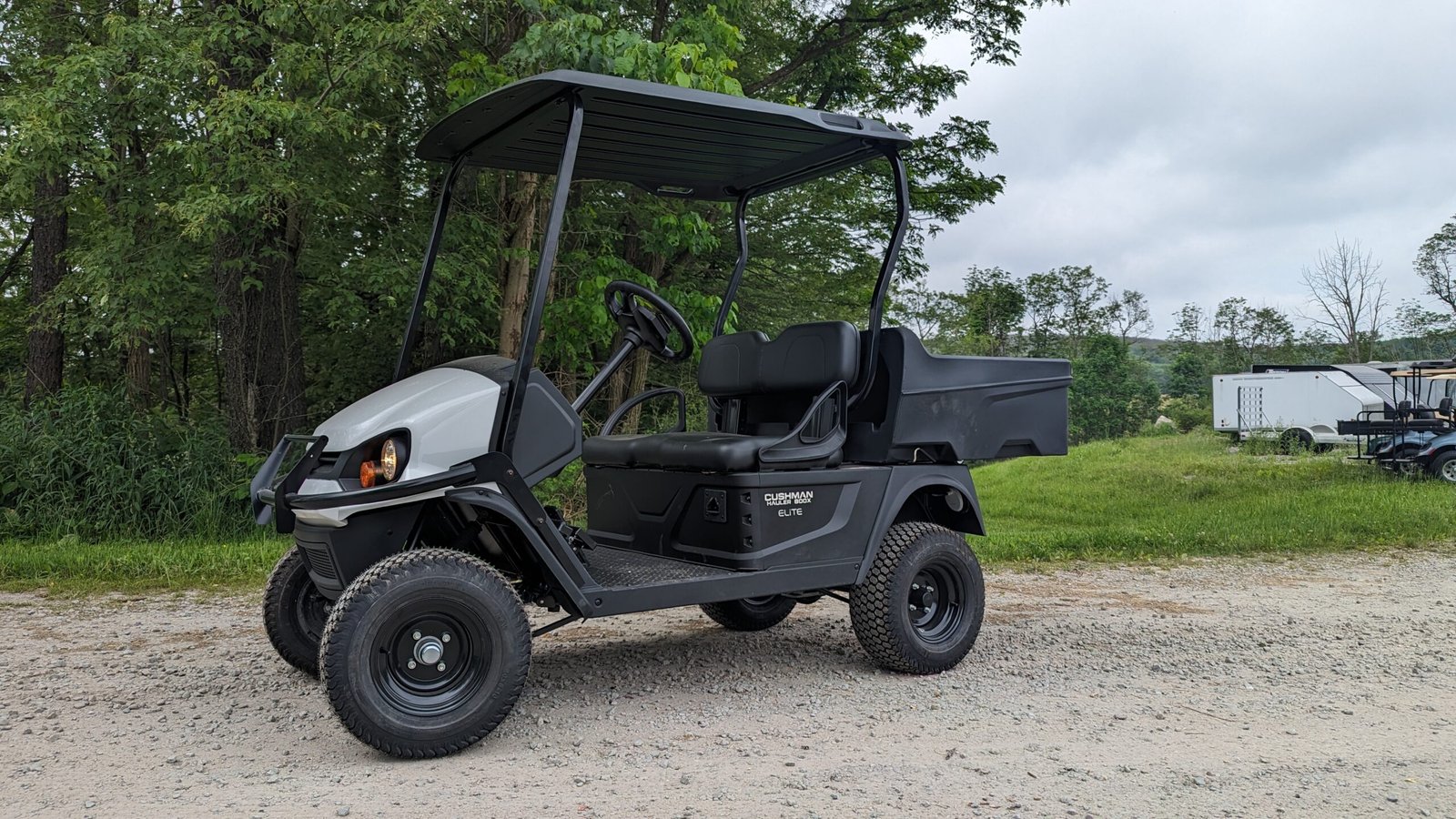
Cushman brake and transaxle faults often show up as drag, grinding, weak takeoff, uneven stopping, or gear noise under utility loads. Real Cushman service-manual specs separate a cheap adjustment from a real transaxle failure.
- Brake shoes must never wear below 0.060 in. (1.5 mm); seized self-adjusters are the most common cause of drag and weak takeoff.
- Parking brake should latch at 65 to 75 lb. of pedal force; drum installation torque is 80 to 90 ft. lbs. before cotter-pin alignment.
- Gas Hauler rear axle takes 51 oz. (1.5 L) Mobil 424; Hauler Pro ELiTE electric takes only 25 oz. (0.7 L) plus friction modifier, do not mix up the two.
- What looks like a worn axle key is usually a stripped brake drum spline or a loose drum nut, verify with a paint-mark load test before ordering parts.
A Hauler spends its life carrying tools, turf gear, and cargo, so brakes and transaxle parts work harder than on a neighborhood cart. Heat, cable stretch, worn shoes, dry pivots, and axle hub wear can all feel like drive problems. This guide uses Cushman’s own service and parts manuals to separate a five-minute adjustment from a real transaxle failure.
Rule Out Brake Drag Before Anything Else
Pedal feel tells you a lot before you jack the cart up. On a healthy Hauler the brake pedal has a firm, short throw; a long spongy pedal that keeps sinking usually means the rear self-adjusters have backed off or a shoe has worn past its service limit. Excess free travel at the top of the parking-brake pedal points at a stretched cable. Note both before you drive, so you can tell an adjustment problem from a mechanical drag problem.
Dragging brakes make the cart feel weak and can overheat hubs. After a short drive, compare wheel heat carefully. One hot side means brake or bearing resistance.
The Cushman Hauler shares its rear brake architecture with the EZGO drum-brake family, since Cushman and EZGO both sit under Textron and reuse a lot of running gear. That means the Hauler 800, 1200, and 1200X built through the 2010s use self-adjusting rear drum brakes with a cable-operated parking brake, and those self-adjusters are the classic weak point. When the star adjuster seizes with rust, one shoe stays proud of the drum and drags constantly. A Hauler that carries heavy turf loads all day sees far more heat cycling than a passenger cart, so this seizing happens sooner. Checking wheel heat side to side after a short loop is the fastest way to catch it.
- Wheel heat: Compare left and right after a short drive.
- Parking brake: Confirm full release.
- Pedal travel: Excess travel points to adjustment or wear.
Symptom-To-Cause Reference
A Cushman golf cart brake transaxle complaint needs numbers, not just “check the brakes.” The older Cushman Shuttle 4X, Hauler 800X and 1200X service manual publishes the mechanical brake checks that separate normal wear from a failed wheel brake, and the current Hauler owner manuals publish the rear axle oil data that separates a service item from a dry transaxle. Use the table as a triage map, then confirm your exact model and serial range before ordering parts.
| Symptom | Verified Cushman data | First exact check |
|---|---|---|
| Pedal feels long, cart pulls, or brakes fade | Brake shoes must never be below 0.060 in. (1.5 mm) at any point; replace before reaching that limit. | Remove both rear drums, measure the most worn shoe area, replace both sides as a set if one is under limit or near it. |
| Brake performance is inconsistent after light use | Self-adjusting drum system needs the adjuster arm to engage and rotate the star wheel; an aggressive stop test can fully expand and release the adjusters when light braking has not done it. | With the drum off, hold the front shoe rearward and operate the lever. If the arm misses the star wheel, replace both wheel brake assemblies. |
| Parking brake takes too much or too little force to latch | Should latch at 65 to 75 lb. (29 to 34 kg) on a scale. Spherical-nut jam nut torques to 10 to 11 ft. lbs. (14 to 15 Nm). | Use a bathroom scale on the pedal, adjust the spherical nut only after shoe condition and free travel are correct. |
| Drum will not come off, or a rear hub clunks under load | Rotate hub until drum hole is at six o’clock, raise the adjuster arm, loosen the star wheel. Drum puller 15947-G1 listed if tapping is not enough. | Do not pry against the backing plate. Inspect drum splines, axle splines, washer position, and drum ledge wear. |
| Drum or axle service was just done and the wheel feels loose | Brake drum installation torque is 80 to 90 ft. lbs. (108 to 122 Nm), then continue to pin alignment, max 140 ft. lbs. (190 Nm). Axle nut torques to 70 ft. lbs. (95 Nm) minimum. | Recheck inner drum washer, drum hub nose past axle splines, and a new cotter pin without backing off the nut. |
| Rear axle whine, oil seep, or heat at the transaxle | Gas Hauler rear axle capacity is 51 oz. (1.5 L) Mobil 424, plus 2 oz. friction modifier on LSD axles. Hauler Pro ELiTE lists 25 oz. (0.7 L) plus 2.0 oz. (59 mL) friction modifier. | Check driver-side rear housing plug; correct level is just below the threaded hole. Do not apply the gas capacity to the ELiTE electric transaxle. |
That is the gap most ranking pages miss: a dragging brake, stripped drum spline, or low axle oil can all feel like a transaxle failure, but the manual gives measurable brake shoe thickness, parking-brake latch force, drum nut torque, and axle oil capacity before the transaxle comes apart.
Hubs, Axle Keys, And Shift Linkage
On these Cushman utility platforms the brake drum is also part of the rear drive path, so “hub problem” often means a worn drum or spline problem rather than a separate golf-cart hub like you might see on another brand. The Hauler 800X gas parts manual lists driver-side brake assembly 612211, passenger-side brake assembly 612189, left brake shoe 612411, trailing brake shoe 612412, gear adjusters 612418 and 612417, and Hauler 800 brake drum assembly 19186G1 with brake drum 18500G2. The same brake pages list Hauler 1000 brake drum assembly 21807G2 with drum 20947G1. Those numbers are parts-manual anchors, not a substitute for serial-number lookup.
For the rear axle itself, the public Hauler 800X parts manual verifies passenger axle shaft 607946, driver axle shaft 607945, slotted nut 606403, rear axle 632513 for vehicles manufactured from April 2014, and optional LSD rear axle 637674. It does not publish a universal separate rear axle key for every Hauler/Titan build. Do not confuse starter/generator key 612035 in the electrical section with a rear axle or drum key. If a forum calls the failure an “axle key,” verify whether your cart actually uses a keyed hub or whether the splined brake drum has stripped.
The practical field check is simple. Raise the rear safely, mark the axle nut and drum, and watch what moves when the drivetrain is loaded lightly. If the axle or nut turns but the wheel/drum does not transmit torque correctly, inspect the drum splines and mating axle splines before condemning the differential. If the drum was recently removed, verify the inner brake drum washer, thrust washer, nut torque, and cotter pin. A loose drum will destroy splines quickly.
Shift linkage can imitate the same failure. The related no-move article’s verified service data applies here too: on the 2012 Hauler 800X and 1200X service platform, single-cable direction-selector adjustment is made with the selector in Reverse. The cam should contact both stops, or contact the reverse stop with no more than a 1/8 in. gap at the Forward stop. A half-selected transaxle can grind, chatter, or feel like stripped internal gears.
Reading Transaxle Oil And Noise
Oil data depends on whether the cart is gas Hauler or ELiTE electric. For current gas Hauler 800 EFI and 1200X models, the verified rear axle fill is 51 oz. (1.5 L) Mobil 424. When the axle is an LSD unit, the service manual says to add 2 oz. of friction modifier during refill. The check and fill plug is on the driver side at the rear of the housing, and the correct level is just below the bottom of the threaded check hole. Unless leakage is visible, the older service manual treats an annual level check as sufficient.
The Hauler Pro ELiTE manual publishes different electric transaxle service data: 25 oz. (0.7 L) Mobil 424, plus 2.0 oz. (59 mL) E-Z-GO friction modifier, with rear axle fluid replacement listed at 500 hours or 5 years. That matters because the ELiTE drive train is direct motor shaft to transaxle pinion shaft, not the same gas CVT and rear axle package.
Noise diagnosis should start at the brake drums and bearings before the center section. A blue or blistered drum, a ledge of unworn metal at the drum friction surface, galling at the splines, oil on the shoes from an axle seal, or a missing inner drum washer can create heat, drag, noise, and poor drive. The service manual says a drum with overheating, scoring, excessive ledge wear, spline galling, wear, or corrosion must be replaced. It also warns not to machine a worn drum true, because turning can make it too thin.
If the brakes pass, check oil level, then isolate whether the sound changes on acceleration, coast, or turns. Whine that rises with road speed plus low oil points toward the axle. Clunking at one rear wheel points toward drum, splines, washer, nut torque, or axle shaft hardware. Grinding only when selecting forward or reverse points back to selector cable travel and neutral lock before internal gears.
The Bottom Line
Cushman brake and transaxle complaints need drag, adjustment, hubs, linkage, oil, and noise checks. Many expensive-sounding failures are cable or hub issues. Work the cheap causes first, because on a Hauler they are the likely ones. Seized self-adjusters, a stretched parking-brake or shift cable, and a flattened axle key account for most of the complaints that owners fear are a blown transaxle. Only after drag, hubs, and linkage are cleared should you open the gearbox. Given how hard these carts are worked, a yearly check of brake adjustment and transaxle oil level saves far more than it costs.
Frequently Asked Questions
Why does my Cushman feel weak after driving a while?
Brake drag can add heat and load until the cart feels weak. Compare wheel heat and check parking brake release.
What causes Cushman transaxle grinding?
Common causes include shift linkage adjustment, clutch drag, low transaxle oil, worn gears, or damaged hubs and axle keys.
Can a bad axle key stop a Cushman from moving?
Yes. A sheared or worn axle key can let the axle turn without driving the wheel correctly.