Club Car Precedent Won’t Go Forward or Reverse
When a Club Car Precedent won’t go forward or reverse but has power, the break is in the drive chain, and on the Precedent the OBC is a prime suspect. This guide tests it in order, with a real documented OBC reset procedure.
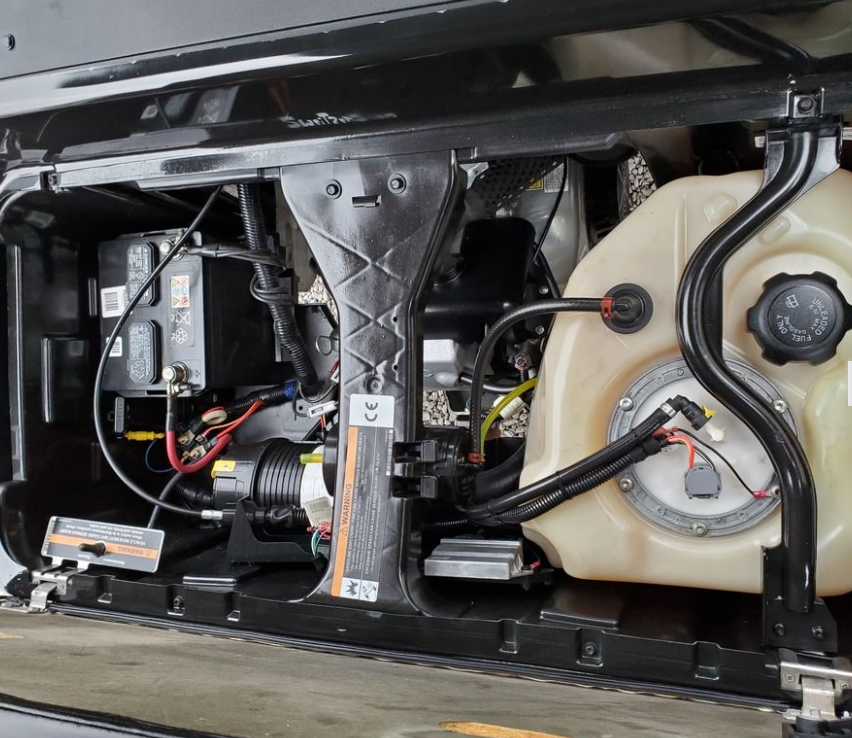
- Lights and power but no drive in either direction means the fault is in the drive chain: solenoid, OBC, F/R switch, or controller.
- Alltrax Technical Note 011 documents a real OBC reset procedure with timing, for pre-ERIC PowerDrive carts specifically.
- Precedent solenoid coil resistance is 200-250 ohms (factory SOL5006) or 180-190 ohms (service replacement SOL0605).
- 2009-and-newer Precedents run more capable IQ/Excel electronics than 2004-2008 carts, and later ERIC-equipped carts replaced the OBC role entirely.
A Club Car Precedent that has lights and power but won’t move in either direction has a break somewhere between the key switch and the motor. Because the Precedent runs an on-board computer (OBC) that can gate the drive circuit, the diagnosis here adds one suspect the older carts don’t have. Work the chain in order: pack, solenoid, OBC, forward/reverse switch, controller, and a multimeter finds the dead link without guesswork.
Power In, No Drive: What It Tells You
Lights, horn, and a key-on response prove the battery and key switch are delivering voltage, so a Precedent that still won’t move has a failure in the high-current drive path, not a dead battery. That focuses the diagnosis on a short list, and on the Precedent, that list includes the OBC. The Precedent shares its platform with the Tempo, so our Club Car Tempo won’t move guide maps closely, and the symptom-specific Precedent no-power, solenoid-clicks guide covers the clicking-but-dead variant.
Why a Club Car Precedent Won’t Go Forward or Reverse
The Precedent drive circuit runs battery, key switch, OBC, forward/reverse switch, controller, solenoid, motor. Every link must pass current; break one and the cart won’t move in either direction. Testing for voltage at each junction shows exactly where it stops:
- OBC, the Precedent-specific suspect; it can gate the drive circuit when confused or failing.
- Solenoid, burnt main contacts stop current to the motor.
- Forward/reverse switch, arced contacts kill one or both directions.
Step-by-Step Test
- Pack & connections. Confirm ~50.9V on a 48V Precedent and wiggle every lug; one corroded connection can stop the cart.
- Solenoid. Press the pedal, listen for the click, then test the contacts under load.
- OBC. If the solenoid and pack are good but the cart’s dead, suspect the OBC.
- F/R switch. Check for output in both Forward and Reverse positions.
- Controller. Voltage in but none out, with all upstream good, means controller.
OBC and Solenoid
Test the solenoid first, cheap and a frequent failure. The 2019 Precedent service manual says two solenoid versions may be found:
| Solenoid Version | Label | Coil Resistance |
|---|---|---|
| Factory-installed | SOL5006 | 200-250 ohms |
| Service replacement | SOL0605 | 180-190 ohms |
| Pre-charge resistor | across large posts | ~250 ohms (batteries disconnected, controller discharged) |
If the solenoid passes and the pack is strong but the Precedent still will not go forward or reverse, turn to the OBC or ERIC generation question. Pre-ERIC PowerDrive carts can have an onboard computer that acts as a go/no-go gate. Later ERIC-equipped Precedents removed that old OBC role: Club Car’s ERIC documentation says the charger is field-programmable instead of changing the onboard computer, uses dV/dt charge termination instead of amp-hour returned termination, and does not use the old CDM display module.
On the Precedent the older OBC sits under the seat on the driver side of the battery pack, while ERIC-era carts use high-frequency charger/controller diagnostics. It is worth knowing that 2009-and-newer Precedents carry more capable IQ and Excel electronics than 2004-2008 cars, and 2014/2015 ERIC-era charging changes the OBC conversation again. One Precedent-specific trap on pre-2015 cars is the MCOR, the throttle position sensor bolted to the accelerator pedal; a worn MCOR can leave the cart electrically alive yet unwilling to move, mimicking an OBC or controller fault.
Forward/Reverse Switch and Controller
The forward/reverse switch carries current on every direction change and its contacts arc and burn over the years, dead in one direction or both points here. Test for switch output on the selected direction: full voltage in, near-zero out confirms burnt contacts. The controller is the last and priciest suspect; if every upstream link tests good but the motor gets nothing, a controller that receives full voltage yet sends no output is the likely failure. The same chain on the older platform is covered in our Club Car DS won’t go forward or reverse guide. For Precedent wiring diagrams, Club Car’s official manuals and support library is the authoritative source.
A Club Car Precedent that won’t go forward or reverse is a chain-break problem with one extra suspect, the OBC. Confirm the pack and connections, test the solenoid contacts against the real resistance specs, rule out the OBC with the documented reset procedure, check the forward/reverse switch, and only then suspect the controller.
How to Confirm the OBC Before You Condemn It
The OBC gets blamed for a lot of Precedent no-drive faults it did not cause, so it pays to confirm it rather than replace it on suspicion. Work the cheaper links first, pack, connections, solenoid, forward/reverse switch, because if any of those is the real break, the OBC is innocent. For older Club Car OBC carts, the most specific public reset procedure found is Alltrax Technical Note 011:
- Key switch OFF, Forward/Reverse in Neutral, Tow/Run in Tow.
- Disconnect the battery negative cable from the pack negative terminal.
- Move Tow/Run to Run, select Reverse, turn the key ON, and lock the throttle pedal down.
- The reverse buzzer should sound and go off in about 30 seconds.
- Leave the cart in that state for 5 minutes to reset the OBC.
- To reconnect, key OFF, Forward/Reverse Neutral, Tow/Run Tow, then reconnect battery negative.
Do not use that as a universal ERIC reset. Club Car’s later ERIC service data instead has a normal safety discharge step: disconnect batteries with Tow/Run in Tow and wait 90 seconds for controller capacitors to discharge before service. If your cart has the ERIC charger system, use CDT/controller diagnostics and charger-interlock testing instead of applying an old PowerDrive OBC reset to the wrong generation. If the Precedent drives after the OBC reset, the memory had simply scrambled rather than failed; if it stays dead with everything else proven good, replacement is justified.
All of the checks above assume the fault is electrical. If the motor spins while the cart stays still, the electrical side has already proved itself and the break is mechanical, which is covered in the guide to a golf cart that will not move while the motor spins.
Frequently Asked Questions
Why won’t my Club Car Precedent go forward or reverse?
Lights and power but no movement in either direction means the break is in the high-current drive path: the solenoid, the OBC (on pre-ERIC carts), the forward/reverse switch, or the controller. Test from the battery outward with a multimeter; the OBC is the Precedent-specific extra suspect the older DS platform doesn’t have.
How do you reset a Club Car Precedent OBC?
The most specific public procedure is Alltrax Technical Note 011: key OFF, F/R in Neutral, Tow/Run in Tow; disconnect battery negative; move Tow/Run to Run, select Reverse, key ON, lock the throttle pedal down; the reverse buzzer should sound and stop in about 30 seconds; leave the cart in that state for 5 minutes to reset the OBC. This applies to pre-ERIC PowerDrive carts, not later ERIC-equipped Precedents.
What solenoid resistance should a Club Car Precedent have?
The 2019 Precedent service manual lists two solenoid versions: factory-installed label SOL5006 at 200 to 250 ohms coil resistance, and service replacement label SOL0605 at 180 to 190 ohms. The pre-charge resistor across the two large posts should read about 250 ohms with batteries disconnected and the controller discharged.
Do all Club Car Precedents have the same OBC?
No. 2009-and-newer Precedents carry more capable IQ/Excel electronics than 2004-2008 carts, and Club Car’s later ERIC charging system replaced the older OBC role: the charger became field-programmable with dV/dt charge termination instead of an onboard computer managing amp-hour-returned termination. Match the reset procedure to the cart’s actual electronics generation.