Club Car Precedent No Power (Solenoid Clicks): Fix
A Club Car Precedent with no power but a clicking solenoid is a classic, fixable fault. This guide isolates whether the problem is the OBC, the solenoid contacts, the pack, or the controller, with real coil-resistance specs and the PowerDrive-vs-ERIC split.
- The click proves the control circuit works, so the fault is in the high-current path: solenoid, pack, OBC, or controller.
- Test the solenoid first: 2V or more across the engaged large posts under load condemns it. Coil resistance is 200-250 ohms (factory SOL5006) or 180-190 ohms (SOL0605).
- The OBC split matters: PowerDrive/OBC Precedents (2004-2014) route charge logic through the computer; ERIC carts (2014.5/2015 up) do not.
- A 48V Precedent should hold about 48-50V and not collapse into the low 30s under load; below 32V the controller can lose communication.
When a Club Car Precedent has no power but you hear the solenoid click each time you press the pedal, you are actually in a good spot: the click proves the low-current control circuit works. The break is almost always in the high-current path, burnt solenoid contacts, a weak pack under load, an OBC that won’t release the charge circuit, or a tired controller. Test those four in order and the fix is usually cheap.
What the Solenoid Click Actually Tells You
That click is a diagnostic gift. To make the solenoid click, the key switch, forward/reverse switch, pedal micro-switch, and the solenoid’s own coil all have to be working. So when your Precedent has no power yet still clicks, you can immediately rule out most of the control side and concentrate on the parts that carry the heavy current to the motor. The pattern, control circuit good and drive circuit dead, narrows the field to four suspects: the solenoid’s main contacts, the pack’s ability to deliver current under load, the on-board computer (OBC) on IQ/Excel carts, and the controller. We covered the universal version in our solenoid clicks but won’t move guide; here we tighten it specifically to the Precedent.
Club Car Precedent No Power vs. No Click
Be precise about your symptom, because the two cases lead opposite directions:
- Clicks, no movement (this guide): control circuit good, high-current path broken. Start at the solenoid contacts.
- No click at all: the coil isn’t being energized; look upstream at the key switch, F/R switch, pedal micro-switch, battery voltage, or the solenoid coil itself.
If you’re not certain which bucket you’re in, our golf cart troubleshooter tool walks you through the same branching logic question by question.
Test the Solenoid Contacts First
This is the decisive Precedent test. Put the meter on DC volts and measure across the two large solenoid studs while the solenoid is clicked in. Near 0V means the contacts are passing current. A reading of 2V or more across the engaged contacts means the contacts are burnt or resistive enough to starve the controller. When you condemn one, the coil-resistance and part references below confirm you have the right solenoid:
| Precedent Solenoid Detail | Spec or Reference | Field Note |
|---|---|---|
| Factory-installed small solenoid | SOL5006 label, coil 200-250 ohms | Measure the two small posts with the batteries disconnected and the circuit safe. |
| Service replacement solenoid | SOL0605 label, coil 180-190 ohms | A very low reading, especially under 40 ohms, points to a defective coil. |
| 2007 Precedent parts reference | 101908701 48V solenoid assembly | Good for serial-range research, not a substitute for ordering by serial number. |
| Common replacement references | 101908701, 102774701, 1014947 | Many stock-style replacements are marketed around 200A. Lifted, high-controller carts may need more contactor than stock. |
| Pre-charge resistor | ~250 ohms across the large posts | Read it with batteries disconnected and capacitors discharged. If open, or if contacts are welded, diagnose before reconnecting. |
If the contact voltage drop is high, replace the solenoid. If the drop is near 0V and the cart still has no drive, move to the OBC/ERIC charge circuit and the pack-load checks instead of guessing at the controller. For modified carts, our 400 amp solenoid upgrade guide explains when a stock 200A contactor is no longer enough.
The OBC and Charge Circuit
The Precedent split matters. Earlier PowerDrive/OBC Precedents route charge-control logic through the onboard computer, and OBC replacement catalogs commonly cross-reference 102511001, 102586301, and 103403201 for 2004-2015 style applications. Later ERIC-equipped Precedents moved to a high-frequency charger and controller diagnostic path, so the old reset-the-OBC routine is not the right first move on those carts.
| Precedent Generation | What to Inspect | Why It Can Mimic No Power |
|---|---|---|
| 2004 to ~2014 PowerDrive/OBC | OBC plug, pack-negative ring terminals, gray charge-wire sense, charger interlock wiring | A bad OBC path can prevent proper charge logic or leave the cart acting dead even when the solenoid clicks. |
| 2014.5/2015 and newer ERIC | Charger receptacle harness, controller B-, charger interlock, red 10-gauge receptacle wire | The 2019 service manual has a 30A fuse near the solenoid in the 10-gauge red receptacle wire and expects 48-50V at the receptacle on a full pack. |
| Any Precedent | Ring terminals, fuse holders, charger-port pins, pack-negative corrosion | Loose or green connections can click the solenoid and still fail under current. |
Keep the ring-terminal check in the routine. If the OBC or charger negative path is loose, corroded, bypassed badly, or connected to the wrong pack point, the no-power symptom can send you chasing the controller. Confirm the cart’s charger generation first, then test the exact path for that system. The deeper charger-path version lives in our Club Car OBC bypass guide.
Battery Pack and Controller
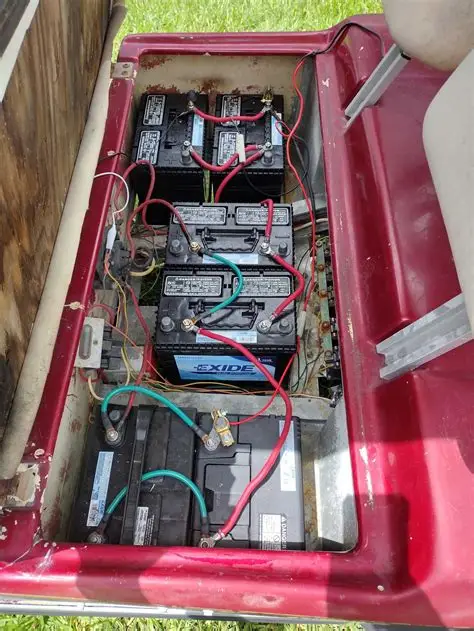
If the solenoid voltage drop is near 0V and the OBC/charger path checks out, load-test the pack where the controller sees it. Club Car Precedent service data flags controller communication problems when pack voltage is below 32V, and the ERIC receptacle test expects full battery voltage, about 48 to 50V on a charged 48V pack, at the charger receptacle. That gives a practical no-drive reading: a 48V Precedent should not collapse into the low 30s when the pedal is pressed. If it does, the controller may simply be starved. Load-test each battery, clean the cable stack, and look for hot cable ends or swollen lead posts.
Only move to the controller after the solenoid contact drop, OBC/ERIC path, and pack sag are known good. A controller can fail, but it is the expensive part of this chain, and it should be the last part you condemn. For the manufacturer’s model-specific wiring diagrams and identification, Club Car’s official manual portal is the authoritative reference.
A Club Car Precedent with no power but a clicking solenoid is rarely a mystery and rarely expensive. The click tells you the control side works, so test the solenoid contacts under load first, then load-test the pack, rule out the OBC by generation, and only suspect the controller once everything cheaper has passed. Replace what the meter condemns, in that order, and the Precedent will be rolling again the same afternoon.
Frequently Asked Questions
Why does my Club Car Precedent have no power but the solenoid clicks?
The click proves the key switch, forward/reverse switch, pedal micro-switch, and solenoid coil all work, so the fault is in the high-current path: burnt solenoid contacts, a weak pack under load, the OBC on IQ/Excel carts, or the controller. Test those four in order and the fix is usually cheap.
How do I test a Club Car Precedent solenoid?
With the key on and pedal pressed so the solenoid clicks, measure DC voltage across the two large solenoid terminals. Near 0V means the contacts are passing current; 2V or more across the engaged contacts means they are burnt or resistive and the solenoid should be replaced. Coil resistance is 200 to 250 ohms on the factory SOL5006 and 180 to 190 ohms on the SOL0605 service part.
Do all Club Car Precedents use the OBC the same way?
No. Earlier PowerDrive/OBC Precedents (roughly 2004 to 2014) route charge-control logic through the onboard computer, with cross-references like 102511001, 102586301, and 103403201. Later ERIC-equipped Precedents (2014.5/2015 up) moved to a high-frequency charger and controller diagnostic path, so the old reset-the-OBC routine is not the right first move on those carts.
What pack voltage should a 48V Precedent hold under load?
Club Car service data flags controller communication problems below 32V, and the ERIC receptacle test expects about 48 to 50V on a charged 48V pack. A healthy 48V Precedent should not collapse into the low 30s when the pedal is pressed; if it does, load-test each battery and clean the cable stack before condemning the controller.