CLUB CAR DS NO POWER
When a Club Car DS has no power at all, dead dash, no response, the fault is in the supply side: the pack, a main connection, or the key switch. This guide finds it fast.
- Diagnose DS no-power complaints as 36V V-Glide or 48V PowerDrive/IQ before applying a test chart.
- Pack voltage at rest is not enough. Load-test the pack and measure cable drop under pedal command.
- On 48V DS carts, charger lockout and OBC inputs can mimic a no-power failure.
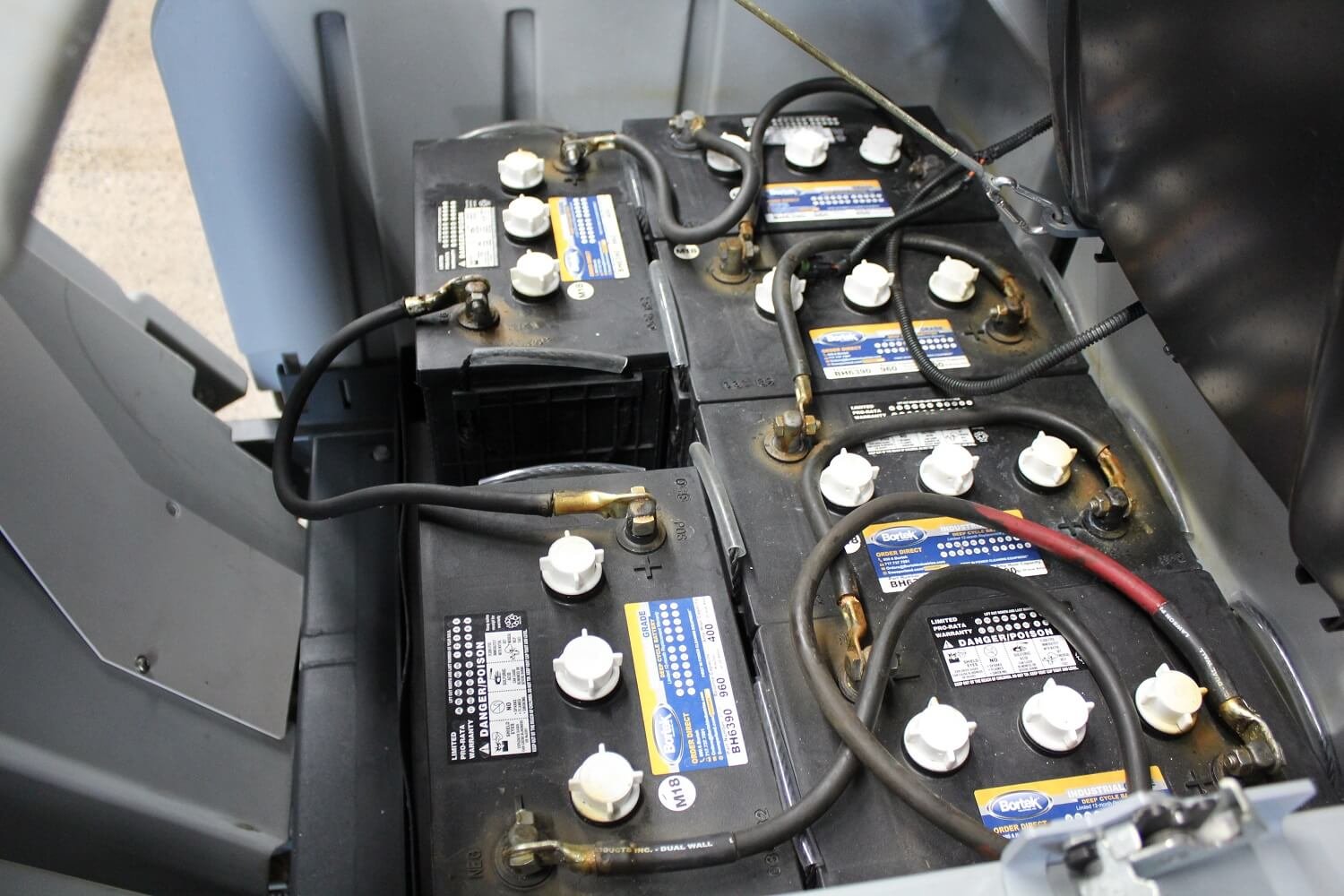
A Club Car DS with no power at all, no lights, no key-on response, nothing, is a power-supply problem, distinct from a cart that has power but won’t drive. Voltage isn’t reaching the rest of the cart, and the break sits in the supply side: the battery pack, a main cable or connection, the key switch, or (on charge-managed carts) the OBC. Work the supply chain from the battery outward and a multimeter pinpoints the dead spot quickly.
01 : Totally Dead vs. No Drive
Club Car DS no power means different things depending on year and system. The DS was sold as a 36V V-Glide electric, a 48V PowerDrive System 48, and a 48V IQ System. The 2002 DS owner manual states those three electric DS models directly, so every meter value needs a 36V or 48V label. A 36V V-Glide cart and a 48V IQ cart do not use the same battery set, OBC behavior, or controller diagnostics.
Start by separating “totally dead” from “key on but no drive.” No accessories and no response points at the pack, main cables, key switch feed, fuse, or charger interlock/OBC state on 48V carts. Lights or accessories with no movement points deeper into the run circuit: key switch output, pedal input, F/R input, solenoid activation, and controller supply. The meter should follow that supply chain in order.
| DS system | Typical pack layout | Full rested | 50% rested | Low or discharged |
|---|---|---|---|---|
| 36V DS V-Glide | 6 x 6V flooded batteries | 38.20V pack, 6.37V each | 36.31V pack, 6.05V each | 34.05V pack, 5.68V each at 0% |
| 48V DS PowerDrive or IQ | Usually 6 x 8V flooded batteries on DS electric | 50.93V pack, 8.49V each | 48.41V pack, 8.07V each | 45.40V pack, 7.57V each at 0% |
| Under-load 48V DS service-manual check | 48V pack under discharge-machine load | 46V to 49V under load is listed as good for a fully charged set | 32V to 46V under load indicates discharged or failed batteries | 32V or less will not activate the discharge machine |
02 : Club Car DS No Power: The Supply Chain
The DS supply chain is battery pack, main cables, key switch, F/R circuit, pedal/MCOR or V-Glide input, solenoid, controller or resistor path, and motor. On 48V IQ cars, the onboard computer also participates in the lockout and charging logic. Club Car’s 2008 DS service manual gives a useful under-load battery test: a fully charged 48V set in good condition should read 46V to 49V while under load, 32V to 46V points to discharged or failed batteries, and 32V or less will not activate the discharge machine.
That under-load number explains the classic “reads fine at rest” trap. A corroded cable or failing battery can show full pack voltage when no current is flowing, then collapse when the solenoid closes. Rested voltage tells state of charge. Loaded voltage tells whether the pack and cables can work.
03 : Battery and Connections First
Do the battery and cable tests before touching the OBC or controller. U.S. Battery says flooded batteries should rest idle for 4 to 6 hours before open-circuit voltage testing, and the Club Car DS service manual warns that unloaded voltage does not always show the true battery condition. Use both tests.
| No-power test | 36V DS expected reading | 48V DS expected reading | Failure branch |
|---|---|---|---|
| Rested pack voltage | 38.20V full, 36.31V at 50% | 50.93V full, 48.41V at 50% | Charge and retest before switch diagnosis if pack is low. |
| Individual batteries | 6.37V full per 6V battery | 8.49V full per 8V battery | Load-test any battery that falls behind the rest. |
| 48V loaded pack test | Not a 36V value | 46V to 49V under load for a good fully charged set | 32V to 46V means discharged or failed batteries. 32V or less is deeply discharged or failed. |
| Cable voltage drop | Measure across each cable while pedal load is applied | Same method | Club Car does not publish one universal mV limit in the DS sources reviewed. Any cable that drops a meaningful share of pack voltage or gets warm is suspect. |
| Terminal torque baseline | Use battery maker hardware spec for installed terminals | Same method | U.S. Battery lists terminal torque by terminal type, so match the battery, not a generic cart value. |
For a quick field check, put the meter leads directly across a suspect cable or lug pair while the pedal is pressed. A good cable should waste very little voltage compared with the whole pack. A corroded or loose cable shows a jump in voltage across the cable and often warms at one end. Replace the cable or repair the terminal before diagnosing electronics.
04 : Key Switch and Fuse
After the pack passes, move to the low-current controls. On 48V IQ DS cars, the Club Car service manual key-switch test says OFF should show no continuity and ON should show continuity across the switch terminals. It also gives a live-voltage MCOR limit-switch test: with tow/run in RUN, key ON, and the F/R switch in neutral, the green wire should read zero until the accelerator is pressed, then approximately full battery voltage when pressed.
| Control test | Expected reading | If it fails | Applies to |
|---|---|---|---|
| Key switch continuity | Open in OFF, continuity in ON | Repair terminals or replace key switch. | 48V IQ test method, useful continuity logic across DS electric systems. |
| MCOR limit switch live check | Zero volts at rest, approximately 48V full battery voltage when pedal is pressed | Check key-switch blue wire, MCOR limit switch, green wire, and pedal adjustment. | 48V IQ DS. |
| Tow/run switch | RUN reads approximately 48V to 50V on the light green wire; TOW below approximately 5V | Replace switch or repair pink/light-green wiring if readings do not change correctly. | 48V IQ DS. |
| Solenoid activation | Handset shows main contactor ON when activated, or meter confirms coil command and contact closure | No activation means input, OBC lockout, coil, or controller-driver path. Click with no drive means contact or cable path. | 48V IQ DS. 36V V-Glide uses a different control path. |
| Main fuse or fuse link | Continuity through the correct fuse for that DS system | Replace with same rating and trace short. Do not upsize. | Model-year specific. |
05 : OBC Considerations
The OBC applies to 48V DS PowerDrive and IQ systems, not 36V V-Glide carts. On the 48V IQ system, Club Car’s service manual identifies a solenoid lockout circuit from the onboard computer to the speed controller at pin 5. The test procedure says pin 5 should be zero volts with the charger connected, then full battery voltage when the charger is disconnected. If that reading is wrong, the manual sends the technician to wire continuity, OBC gray wire/fuse, and tow/run switch checks.
The owner manual also explains why a charger state can look like a no-power problem: while the charger is plugged in, the vehicle control circuit is locked out. That is normal. A confused or failed OBC can leave the cart acting locked out after charger service, deep discharge, or wiring faults. The correct repair is not to randomly bypass wires. Confirm pack health, charger plug state, gray sense lead, fuse, tow/run input, and solenoid lockout output first.
For the site’s practical bypass/reset procedure, use the Club Car OBC bypass and reset guide. This article only scopes what the OBC gates: charger communication and the 48V IQ lockout path. It does not duplicate bypass wiring steps because the exact procedure depends on the charger conversion and harness.
The hidden killer: corroded cables that read fine at rest
A corroded DS battery cable can show pack voltage on a meter with no load because a digital meter needs almost no current. The same cable can fail the moment the solenoid closes. Test across the cable while the pedal circuit is calling for drive, compare battery-side voltage to controller-side voltage, and look for a warm lug after a short failed attempt. A hot lug, green corrosion, swollen insulation, or a voltage drop that steals useful pack voltage means the cable is part of the failure, even if a static meter reading looked normal.
Rule out the obvious before you meter
Before opening the controller area, confirm the charger is unplugged, the tow/run switch is in RUN on 48V carts, the F/R selector is fully seated, the key is ON, and the pack is charged. On 48V IQ carts, a charger-connected state can intentionally lock out the control circuit. On 36V V-Glide carts, the problem is often more mechanical and contact-based. These checks take less than a minute and prevent chasing an OBC, solenoid, or controller when the cart is simply disabled by a normal operating state.
A Club Car DS with no power must be diagnosed as either 36V V-Glide or 48V PowerDrive/IQ. A 36V flooded pack is about 38.20V full and 36.31V at half charge. A 48V flooded pack is about 50.93V full and 48.41V at half charge, and Club Car’s 48V loaded test expects 46V to 49V under load from a fully charged good set. Prove the pack and cables under load, then test key switch continuity, fuse continuity, pedal input, tow/run state, solenoid supply, and OBC lockout on 48V carts. If a cable reads fine at rest but drops voltage or heats under load, fix that before blaming the controller.
FAQ
Why does my Club Car DS have no power at all?
A Club Car DS with no power at all usually has a dead or deeply discharged battery pack, a corroded or broken main cable connection, a failed key switch, or on some models an OBC issue. Test pack voltage and the main connections first, they cause the majority of totally-dead carts.
How do I tell a dead battery from a bad connection on a DS?
Measure total pack voltage at the main terminals, then measure each battery. If the pack reads good but the cart is dead, the break is a connection, the key switch, or a fuse downstream. If the pack reads low, charge or service the batteries and look for one weak battery dragging the string.
Will a bad OBC stop a Club Car DS from powering on?
On 48V PowerDrive and IQ DS carts, yes, an OBC or its lockout circuit can prevent drive, especially if the charger is connected or the gray sense-lead and tow/run inputs are faulty. It does not apply to a 36V V-Glide DS. Prove the pack, charger-disconnected state, tow/run setting, key and pedal inputs, fuse continuity, and solenoid command before calling the OBC bad or bypassing anything.
How do I load-test DS battery cables?
Put the meter probes directly across one cable or lug pair while the cart is safely commanded to drive. A healthy cable wastes very little of the pack voltage. A large drop, heat at a lug, green corrosion, swollen insulation, or lower voltage at controller B+ than at the pack identifies a cable or connection fault. Test one segment at a time before replacing a controller.