
Charger Clicks But Won’t Charge
You hear the reassuring click, but the next morning the cart is dead. This guide diagnoses the open-loop failure in the DC charging circuit, with real per-platform fuse references and Delta-Q and Lester fault codes.
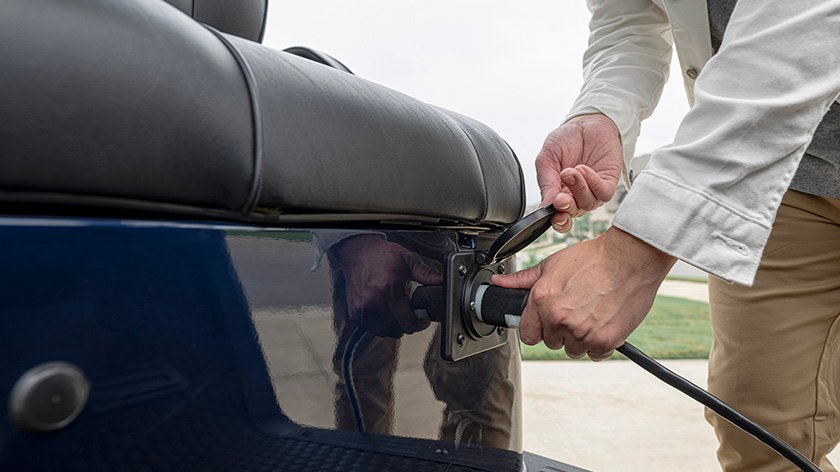
- A click means the AC relay engaged, so wall power is fine; the roadblock is on the DC side, usually a cheap fuse.
- Fuse references by platform: E-Z-GO TXT 60A (OEM 602632), Club Car PowerDrive 3/8A gray-wire, ERIC Precedent 30A red receptacle wire.
- Sensing voltage is charger-specific: Delta-Q QuiQ needs about 0.5V/cell (newer) or 1V/cell (older); Lester Summit II shows LOW DC under about 10V.
- Read the fault code before tearing into fuses: QuiQ red flashes 1-6 and Lester faults point you to the real problem.
A click only tells half the story. It means the AC wall power is working and the relay is engaging. If the ammeter stays at zero, the DC side has a roadblock, most often a cheap receptacle fuse. To fix this, visualize the path electricity travels: transformer, rectifier, internal fuse, DC cord, receptacle fuse, battery. Break any link and you get a click but no charge.
Culprit #1: The Receptacle Fuse
The charger can click and still never reach the pack if the receptacle fuse, sense wire, or DC cord path is open. Test the cart side first because it is exposed to water, loose plugs, and overheated pins.
| Platform | Fuse or Receptacle Reference | What to Test |
|---|---|---|
| E-Z-GO TXT/Medalist 1996-up | 60A charger receptacle fuse, commonly OEM 602632 | Check pack voltage on the back of the receptacle and across the fuse. Pack voltage on one side only means the fuse is open. |
| E-Z-GO RXV | Platform-specific receptacle protection and wiring | Back-probe the port for pack voltage and inspect the pins for heat. Replace the port if voltage disappears through the receptacle under load. |
| Club Car PowerDrive/OBC | Gray-wire sense fuse, commonly 3/8 amp (1018949-01, 1017968-01 style) | If the gray/sense path is open, the charger may click but not start correctly. |
| Club Car ERIC Precedent/Tempo | 30A fuse near the solenoid in the 10-gauge red receptacle wire (2019 service data) | A full pack should show about 48 to 50V at the receptacle. If it does not, test the fuse and red/black receptacle leads. |
Use slow-blow or OEM-style fuses where the platform calls for them. If the new fuse blows instantly, stop replacing fuses and find the shorted cord, melted receptacle, reversed polarity, or internal charger fault that caused it.
Culprit #2: The Internal Charger Fuse
If the receptacle fuse is good, the problem is inside the box. Warning: unplug from wall and cart before opening, because capacitors hold a lethal charge.
- Location: near the thick DC output wires, often a white ceramic fuse or copper strip.
- The test: set the multimeter to continuity (beep). Touch probes to both ends. No beep means blown.
Culprit #3: Too Dead to Charge
Many older golf-cart chargers need enough pack voltage to recognize the battery before the relay stays closed. That is why a charger may click once, blink, and quit on a deeply discharged cart. But the exact wake-up point is charger-specific, not one universal 32 to 36V rule.
| Charger Family | Published Low-Voltage Clue | Practical Meaning |
|---|---|---|
| Delta-Q QuiQ | Will not start below about 0.5V per cell; older software about 1V per cell | On a 48V lead-acid pack, roughly 12V (newer) or 24V (older). Some profiles use low-current recovery before normal charging. |
| Lester Summit II | LOW DC means battery voltage too low to start, published as under 10V | Recover batteries individually or use the approved low-voltage recovery procedure before expecting the charger to run. |
| Transformer-style chargers | Often need a much higher sensing voltage before the relay closes | The old 32 to 36V field rule still fits many legacy 48V carts, but do not apply it to every smart charger. |
If the pack is deeply discharged, charge individual batteries with the correct 6V, 8V, or 12V automotive-style charger until the pack rises into the charger-recognition range. Then reconnect the golf-cart charger and confirm pack voltage rises.
Diagnose It With the Decision Matrix
| Symptom | Most Likely Cause | Best Next Test |
|---|---|---|
| Charger clicks once and shuts off | Pack below the charger’s sensing threshold | Measure total pack voltage and compare with the charger family above. |
| Clicks, fan or LEDs start, pack voltage never rises | Open DC cord, receptacle fuse, internal fuse, or failed output | Measure charger-side output at the DC cord, then at the cart receptacle. |
| Fuse blows as soon as the charger connects | Shorted receptacle, reversed wiring, damaged cord, or rectifier fault | Inspect polarity and isolate the charger from the cart before installing another fuse. |
| Delta-Q red fault flash | Low battery, timeout, check battery, over-temperature, or internal fault | Count the flashes and match them to the Delta-Q table below. |
| Lester Summit II fault | LOW DC, max time, max amp-hours, hardware, or AC input fault | Use the charger LEDs or ChargerConnect data instead of guessing from the relay click. |
Testing the DC Charge Cord
Wires often break internally inside the rubber handle due to stress. Set the meter to continuity, touch one probe to the positive pin on the handle and the other to the positive wire inside the case, then wiggle the handle while testing. If the beep stops and starts, the wire is broken internally.
Old Ferro Chargers vs New Smart Chargers
Smart chargers tell you more than old transformer boxes, but only if you read the code before unplugging them. Write down the LED pattern or app fault, then test the pack, cord, and receptacle against that code.
| Charger | Fault Clue | What It Points To |
|---|---|---|
| Delta-Q QuiQ | 1 red flash | High or wrong battery voltage for the charger profile. |
| Delta-Q QuiQ | 2 red flashes | Low battery voltage. Check nominal pack voltage and recover batteries if needed. |
| Delta-Q QuiQ | 3 red flashes | Charge timeout. The pack did not finish normally in the expected time. |
| Delta-Q QuiQ | 4 red flashes | Check battery. The pack may not reach the minimum level for the normal cycle. |
| Delta-Q QuiQ | 5 red flashes | Over-temperature. Check charger cooling and ambient heat. |
| Delta-Q QuiQ | 6 red flashes | Internal charger fault. Reset once, then service or replace if it returns. |
| Lester Summit II | LOW DC / MIN VOLTAGE | Pack voltage too low to start or failed to reach the expected minimum. |
| Lester Summit II | MAX TIME / MAX AMP-HOURS | Battery problem, wrong profile, or charger cannot complete the programmed charge. |
For charger-side output, measure DC volts at the charger’s DC plug or cord end first, then at the cart receptacle. If the charger shows charging but the pack voltage does not climb above resting voltage within a few minutes, the output path is open or the charger is not actually producing DC under load.
Why the Fuse Blew in the First Place
Replacing a blown 60-amp receptacle fuse gets you charging again, but if you do not ask why it blew, you will be back under the seat next week. On E-Z-GO TXT and RXV carts, the most common cause is a corroded or loose connection at the receptacle that creates resistance and heat until the slow-blow fuse finally gives up. On a Club Car Precedent, the inline gray-wire fuse often blows because the yellow rubber holder cracks with age and lets moisture in, or because a battery in the string has shorted. Before you install the new fuse, check every ring terminal for a rainbow heat tint, tighten the connections, and load-test the batteries so you are fixing the cause, not just the symptom.
A charger that clicks but never charges is almost always a broken DC path. Check the receptacle fuse first, verify pack voltage against your charger’s sensing threshold, read any smart-charger fault code, and inspect the cord with the wiggle test. Only when the fuses, cord, and batteries all check out is the charger’s own transformer, rectifier, or control board the likely failure.
When the Charger Itself Is Done
There is a point where fuses and wake-up tricks are just delaying a replacement. If both the receptacle fuse and the internal fuse test good, the cord passes the wiggle test, and the batteries are healthy and above the sensing voltage, yet the charger still clicks or hums with zero amps, the transformer, rectifier, or control board has likely failed. Older ferroresonant chargers are heavy and can sometimes be repaired at the rectifier, but many owners find a modern replacement charger is cheaper and safer than chasing a failing high-voltage board. Whatever you decide, always unplug from both the wall and the cart and let the unit sit before opening it, because the internal capacitors can hold a dangerous charge long after everything looks dead.
If the symptom is not clicking but silence, a stall partway through, or a charge that never completes, the branch by branch approach is in the charger not charging fault tree.
Frequently Asked Questions
Why does my golf cart charger click but won’t charge?
The click means the AC relay is engaging, so wall power is fine. When a golf cart charger clicks but won’t charge, the roadblock is on the DC side: a blown receptacle or internal fuse, a broken DC cord, or a pack so low the charger cannot sense it. Test the cart-side fuse and pack voltage first.
Where is the fuse on my golf cart charger?
On E-Z-GO TXT/Medalist carts it is a 60A charger receptacle fuse (commonly OEM 602632). Club Car PowerDrive carts use a small 3/8-amp gray-wire sense fuse; ERIC-era Precedents use a 30A fuse in the 10-gauge red receptacle wire. If pack voltage shows on one side of the fuse only, the fuse is open.
What voltage does a charger need to sense before it starts?
It is charger-specific, not one universal 32 to 36V rule. Delta-Q QuiQ chargers will not start below about 0.5V per cell on current software (roughly 12V on a 48V pack) or about 1V per cell on older software. Lester Summit II shows LOW DC below about 10V. Transformer-style chargers often need much higher sensing voltage, and the old 32 to 36V field rule still fits many legacy 48V carts.
What do the red flashes on a Delta-Q charger mean?
On a QuiQ: 1 flash is high or wrong battery voltage, 2 is low battery voltage, 3 is charge timeout, 4 is check battery, 5 is over-temperature, and 6 is an internal charger fault. Count the flashes and match them to the table before assuming a blown fuse, because the code often points somewhere else entirely.
