EZGO MARATHON WON’T CHARGE
When an EZGO Marathon won’t charge, the charger usually refuses to start because pack voltage is too low or a connection is broken. This guide gets the charger to engage again, in order.
- A Marathon charger that stays off often cannot see enough battery voltage or cannot see the pack through the receptacle.
- Measure the full 36V pack and each 6V battery before calling the charger bad.
- PowerWise QE threshold values are charger-family specific, not universal rules for every Marathon-era charger.
The EZGO Marathon (the workhorse built into the mid-1990s) uses a charger that will not turn on unless it first senses enough voltage from the battery pack. So a Marathon that won’t charge is frequently not a broken charger at all, it’s a pack that has sagged below the charger’s wake-up threshold, a corroded connection, or a blown fuse. Work through the checks below in order and you’ll usually have it charging again without buying anything.
01 : Why the Marathon Charger Stays Off
An EZGO Marathon won’t charge symptom usually splits into two buckets: the charger is not being allowed to start, or the battery pack is too weak or too disconnected for the charger to recognize. Marathon-era carts are commonly 36V lead-acid carts using six 6V batteries, and many still use older PowerWise style chargers. Later 36V PowerWise QE documentation is useful for voltage logic and LED behavior, but it is not proof that every older Marathon charger uses the same board or code table.
Start with the pack, not the charger case. A 36V cart should be tested as a full pack and as six individual batteries. Trojan’s maintenance guidance says open-circuit voltage and specific gravity are both useful state-of-charge checks, and its FAQ lists 1.277 specific gravity or greater as a full-charge clue for most Trojan flooded batteries at 80 degrees F. If one 6V battery is far lower than the others, the charger problem may really be a battery problem.
| Charger symptom | Pack voltage | Next test | Likely repair |
|---|---|---|---|
| No hum, no click, no ammeter movement | Very low or unknown | Measure full pack at the main positive and negative, then at the receptacle. | Recover or replace batteries if pack voltage is below the charger’s wake-up range. |
| Clicks once then quits | Near normal 36V but unstable | Wiggle charger plug and receptacle while watching voltage. | Clean or repair receptacle contacts, plug, DC cord, or auxiliary contact. |
| Ammeter jumps high then falls to zero | Normal at rest | Check each 6V battery during charge start. | Replace the battery that spikes, collapses, or vents abnormally. |
| Charger runs but never finishes | Pack rises but one battery lags | Compare each battery after rest and during charge. | Battery pack fault more likely than charger fault. |
| Known good pack, no charger output | Healthy 36V pack at receptacle | Check charger fuse, cord continuity, relay/control board, and diodes according to charger model. | Charger-side repair or replacement. |
02 : The Voltage Threshold That Makes an EZGO Marathon Won’t Charge Symptom
Many automatic golf-cart chargers need to see battery voltage before they turn on. Delta-Q’s E-Z-GO PowerWise QE 36V manual says the charger is for 36V battery systems, moves from trickle to full current once a minimum of 2 volts per cell is reached, and gives a two-red-flash battery voltage fault when the pack is below 27.0V or above 50.4V. That is a verified number for that 36V PowerWise QE manual, not a universal number for every older ferroresonant Marathon charger.
Use the value correctly. A 36V lead-acid pack has 18 cells, so 2 volts per cell equals 36V. A severely discharged pack may need controlled recovery before the normal cart charger will work. East Penn’s golf car battery care sheet gives a separate charging reference for individual 6V batteries, saying to charge to at least 6.9V but no more than 7.3V at 77 degrees F. That is useful when recovering individual 6V batteries with the correct external charger, but it is not a permission to leave a shop charger unattended on a golf cart pack.
If the pack is below the charger wake-up threshold, charge each 6V battery individually with an appropriate charger until the pack is high enough for the cart charger to recognize it, then reconnect the cart charger and monitor. If one battery will not rise or quickly falls after rest, replace or professionally load-test the pack before diagnosing the charger.
03 : Step-by-Step Diagnosis
- Confirm AC power. Test the wall outlet and avoid light-duty extension cords. Charger manuals require a grounded outlet and warn against unsafe adapters.
- Measure full pack voltage. Put the meter on the main pack positive and negative. Record the number before plugging in the charger.
- Measure each battery. Six 6V batteries should be close to each other after rest. A single low battery can stop or confuse the charge cycle.
- Measure at the cart receptacle. If pack voltage is present at the batteries but missing at the receptacle, the fault is the receptacle, fuse, wiring, or a broken connection between pack and charge port.
- Inspect the charger plug. Look for heat damage, loose pins, corrosion, and a damaged DC cord. Delta-Q’s PowerWise QE instructions specifically call for keeping charger connections tight and clean and cleaning the DC connector auxiliary contact if the charger cuts out when the handle is moved.
- Split charger from pack. If a known-good charger works on the cart, the old charger is suspect. If two chargers refuse the same cart, the cart-side pack or receptacle path is suspect.
During storage, E-Z-GO service information warns that the battery charger and controller are sources of electrical drain and tells owners to unplug the charger DC plug from the vehicle receptacle. That matters for Marathons parked for months: a pack can self-discharge and parasitic loads can pull it below the charger’s start range. If your symptom is a charger that clicks but does not deliver charge current, compare the pattern with the charger clicks but no charge troubleshooting guide.
04 : Connections, Fuse, and Plug
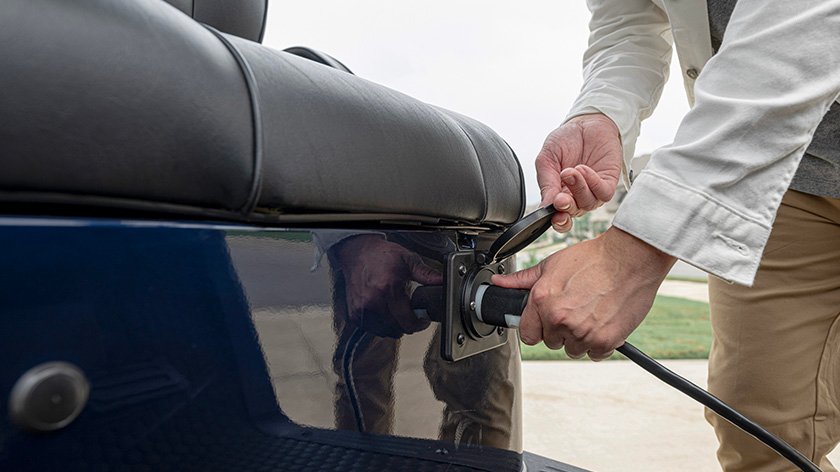
The charge receptacle and plug are common Marathon-era failure points because every charge cycle heats, moves, and stresses the contacts. Inspect the receptacle face for melted plastic, green corrosion, pushed-back terminals, and loose mounting hardware. Then measure voltage at the receptacle. Pack voltage at the batteries but not at the receptacle means the charger cannot see the pack, so it may never start.
Older E-Z-GO PowerWise chargers often have a DC output fuse in the charger. RMI’s PowerWise repair guide identifies a PowerWise 50 amp fuse as a common service item and gives 28106G01 as a replacement reference. Treat that as a charger-model reference, not a universal Marathon part number. Confirm the charger model label before ordering. If the fuse is open, do not just replace it and walk away. Test the diodes, cord, and board because a blown fuse can be a symptom of a shorted charger component.
For PowerWise QE 36V chargers, the manual gives useful fault-code logic: one red flash indicates a charge-enable fault such as poor DC connector contact, two red flashes indicate a pack voltage fault below 27.0V or above 50.4V, and six red flashes indicate an internal charger fault that needs qualified service if it repeats after reconnecting. Older Marathon chargers may use mechanical hum and ammeter behavior instead of the same LED flashes, so match the diagnostic to the actual charger.
05 : Charger vs. Pack: The Final Split
Once the pack is high enough, the batteries are close to each other, and voltage reaches the receptacle, the split becomes simple. A charger that will not start on a known-good 36V cart has a charger-side fault. A charger that works on another cart but not the Marathon is seeing a cart-side fault. A charger that starts but times out while one battery remains low is usually exposing a weak battery, not causing it.
Use a hydrometer on flooded batteries when possible. Trojan notes that specific gravity can identify state of charge and help locate weak or improperly maintained batteries. A battery with one cell far behind the others is not fixed by replacing charger boards. It needs battery service, equalization if the manufacturer allows it, or replacement.
Do not bypass charger relays or defeat interlocks as a repair. Temporary bench tests belong to qualified charger repair because charger capacitors and transformer output can injure you even after unplugging. For a garage diagnosis, the safe endpoint is: pack voltage, individual battery voltage, receptacle voltage, plug condition, fuse continuity with power disconnected, and comparison with a known-good charger. If the same Marathon also has a solenoid click or no-drive issue after charging is restored, use the E-Z-GO solenoid click diagnosis as the next split.
06 : Bottom Line
When an EZGO Marathon will not charge, prove the 36V pack before blaming the charger. Measure full-pack voltage, compare all six 6V batteries, confirm voltage at the receptacle, inspect the plug and fuse, and only then open the charger-side diagnosis. Verified PowerWise QE documentation gives a 27.0V low-pack fault for that 36V charger family, but Marathon-era charger behavior varies by charger model. If the value is not printed in the manual for your charger, use it as a clue, not a universal rule.
What drains a Marathon pack flat in the first place
A Marathon pack often ends up below charger wake-up range after storage, not after one bad drive. Old flooded batteries self-discharge, dirty battery tops can leak current, accessories can be wired direct, and a charger left connected may still create a small electrical drain depending on the system. Store the pack fully charged, clean the cases, disconnect unnecessary loads, and recheck voltage during long storage. A battery that sits discharged sulfates, loses capacity, and may no longer recover enough for the normal charger to complete a cycle.
An EZGO Marathon charger that stays off is usually reacting to what it sees at the batteries or receptacle. Confirm full-pack voltage, each 6V battery, and charge-port voltage before opening the charger.
FAQ
Why won’t my EZGO Marathon charger turn on?
The charger may not be seeing enough battery voltage, or voltage may not be reaching the charge receptacle. Start by measuring the full pack, each battery, and voltage at the receptacle.
What voltage should a 36V Marathon pack have?
A healthy charged 36V lead-acid pack should be well above nominal voltage after charging and rest, but the exact reading depends on battery type, temperature, and state of charge. Compare all six 6V batteries to find one weak unit.
Can one bad battery stop the charger?
Yes. One low or failed 6V battery can pull the pack below the charger’s start range or make the charger time out. Test each battery instead of reading only the full pack.
Is a PowerWise QE fault threshold valid for every Marathon charger?
No. The 27.0V low-pack fault is documented for the 36V PowerWise QE manual cited in the article. Older Marathon chargers can behave differently, so match the test to the charger model label.